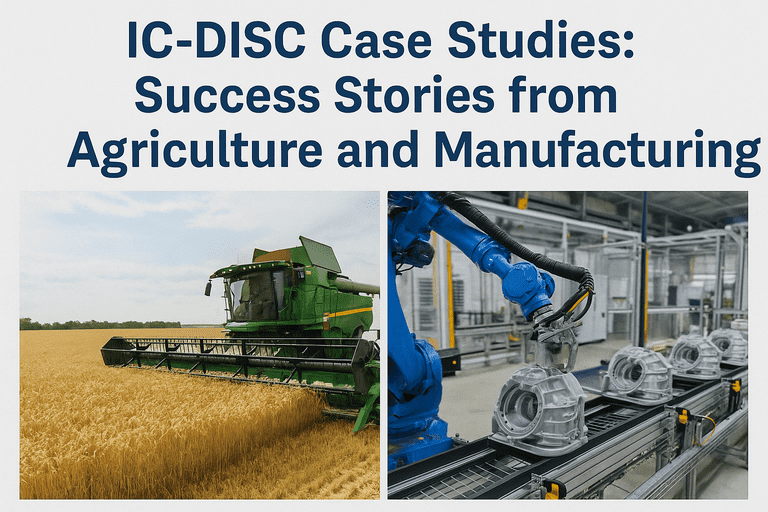
The Interest Charge Domestic International Sales Corporation (IC-DISC) is a powerful tax-saving tool for U.S. exporters, offering tax deferral and reduced rates on export income, especially valuable with the Qualified Business Income (QBI) deduction expiring in 2025. While WTP Advisors’ aerospace case study showcases a 263% savings increase, industries like agriculture and manufacturing also benefit significantly. This article presents detailed IC-DISC case studies from agriculture and manufacturing, highlighting eligibility, implementation, savings, and lessons learned, with insights from WTP Advisors’ expertise. For tailored IC-DISC solutions, visit WTP Advisors IC-DISC Services.
Why IC-DISC for Agriculture and Manufacturing?
Agriculture and manufacturing are key U.S. export sectors, producing goods like crops, processed foods, machinery, and industrial parts that qualify as export property (≥50% U.S. content, destined for foreign use, per IRS Reg. 1.993-3). The IC-DISC enables:
-
Tax Savings: Shift export income to a tax-exempt IC-DISC, with dividends taxed at 20% (vs. 37% ordinary income post-QBI sunset).
-
Deferral: Defer up to $10M in commissions, paying a small interest charge (~4-5% T-bill rate in 2025).
-
Scalability: Benefits suit small to mid-sized exporters, common in these sectors.
Case Study 1: Midwest Agricultural Exporter
Business Profile
-
Company: GreenFields Co., a family-owned LLC in Iowa exporting $2.5M in organic grains and processed foods (e.g., corn, soybeans) to Europe and Asia.
-
Challenge: High ordinary tax rates (37% post-QBI) strained cash flow, limiting equipment upgrades and market expansion.
-
Export Volume: $2.5M annually, with 80% qualifying as export revenue (U.S.-grown, foreign-destined).
IC-DISC Implementation
-
Eligibility Confirmation: WTP Advisors verified that 80% of GreenFields’ revenue met IRS criteria (≥50% U.S. content, foreign use). Non-qualifying domestic sales were excluded.
-
Setup: Formed a Delaware IC-DISC (“GreenFields IC-DISC, Inc.”) for ~$200, issued $2,500 in stock, and filed IRS Form 4876-A within 90 days.
-
Commission Calculation: Used the 50% taxable income method, enhanced by WTP’s transaction-by-transaction (TxT) analysis to optimize commissions across grain types.
-
Compliance: Maintained separate books, paid commissions within 60 days (Reg. 1.994-1), and prepared for 2025 Beneficial Ownership Information (BOI) filing per the Corporate Transparency Act.
Outcome
-
Savings (Post-QBI 2025):
-
Export Income: $2M qualified receipts.
-
Commission: $1M (50% method, optimized via TxT).
-
Tax Without IC-DISC: $1M × 37% = $370,000.
-
Tax With IC-DISC: $1M dividend × 20% = $200,000.
-
Savings: $170,000 (8.5% of receipts).
-
-
Deferral: Deferred $800,000 for equipment upgrades, paying a 4.5% interest charge.
-
Additional Benefits: WTP’s TxT method increased savings by 15% over standard methods, similar to their GlobalTech Solutions case.
-
Compliance: WTP’s ExPortal tool ensured audit-ready records and timely BOI filing.
Lessons Learned
-
Granular Analysis Pays Off: TxT analysis maximized commissions by accounting for varying margins across grain exports.
-
Early Compliance: Preparing for BOI filing avoided $591/day penalties.
-
Cash Flow Impact: Deferral funded critical upgrades, boosting competitiveness.
Case Study 2: Manufacturing Firm
Business Profile
-
Company: Precision Parts Inc., a mid-sized S-corp in Ohio exporting $4M in industrial components (e.g., machinery parts, tools) to Latin America and Asia.
-
Challenge: Rising tax burdens post-QBI sunset limited R&D investment for new product lines.
-
Export Volume: $4M annually, with 90% qualifying as export revenue (U.S.-manufactured, foreign-destined).
IC-DISC Implementation
-
Eligibility Confirmation: WTP verified 90% of revenue as qualified export receipts, ensuring ≥50% U.S. content via supplier certifications.
-
Setup: Formed a Delaware IC-DISC for ~$300, issued $2,500 in stock, and filed Form 4876-A.
-
Commission Calculation: Applied marginal costing for low-margin parts, combined with WTP’s TxT method to optimize commissions.
-
Compliance: Ensured timely commission payments, separate books, and BOI filing preparation for 2025. Integrated R&D expenses to boost commissions (aligned with R&D tax credits).
Outcome
-
Savings (Post-QBI 2025):
-
Export Income: $3.6M qualified receipts.
-
Commission: $1.8M (marginal costing + TxT).
-
Tax Without IC-DISC: $1.8M × 37% = $666,000.
-
Tax With IC-DISC: $1.8M dividend × 20% = $360,000.
-
Savings: $306,000 (8.5% of receipts).
-
-
R&D Synergy: Allocated $500,000 in R&D expenses, increasing commissions by $100,000 and claiming $100,000 in R&D credits (20% of QREs).
-
Deferral: Deferred $1M for R&D, paying a 4.5% interest charge.
-
WTP Role: Used ExPortal for compliance and TxT for optimization, mirroring their 263% aerospace savings case.
Lessons Learned
-
Marginal Costing for Low Margins: Boosted commissions for low-margin parts, critical for manufacturing.
-
R&D Integration: Combining IC-DISC with R&D credits doubled savings.
-
Audit Readiness: Robust documentation prevented IRS scrutiny, per IRS IC-DISC Audit Guide.
Key Strategies for Success
-
Verify Eligibility: Confirm U.S. content and foreign use with supplier records and shipping documents. WTP’s assessments ensure accuracy.
-
Optimize Commissions: Use WTP’s TxT method or marginal costing for low-margin goods, as in the manufacturing case.
-
Leverage Deferral: Defer commissions to fund growth (e.g., equipment, R&D), as both cases did.
-
Ensure Compliance:
-
Maintain separate books and pay commissions within 60/90 days (Reg. 1.994-1).
-
File BOI reports by January 1, 2025, to avoid penalties ($591/day).
-
-
Integrate Incentives: Combine with R&D credits, as in the manufacturing case, for maximum savings.
-
Annual Redeterminations: Adjust commissions yearly for export volume or currency changes, using WTP’s ExPortal.
Challenges and Solutions
-
Challenge: Proving U.S. content in complex supply chains (agriculture/manufacturing). Solution: WTP’s expertise verifies content with supplier certifications.
-
Challenge: Low margins reducing commissions. Solution: Marginal costing, as used in the manufacturing case, boosts savings.
-
Challenge: Audit and BOI compliance risks. Solution: WTP’s ExPortal ensures audit-ready records and timely BOI filings.
Why Act in 2025?
The QBI sunset increases IC-DISC’s tax savings to ~17%, making it critical for agriculture and manufacturing exporters. With rising IRS scrutiny, robust compliance is essential. WTP’s 20 years of experience, as noted in their anniversary blog, ensures success.
How WTP Advisors Helps
-
Eligibility: Verifies export revenue and U.S. content.
-
Setup: Manages IC-DISC formation and BOI filings.
-
Optimization: Uses TxT and ExPortal for maximum savings, as in their 263% aerospace case.
-
Compliance: Prepares audit-ready records for IRS and FinCEN. Action Item: Contact WTP at IC-DISC Services for a free consultation.
Conclusion
These agriculture and manufacturing case studies demonstrate the IC-DISC’s power to deliver tax savings and fuel growth, especially post-QBI sunset in 2025. With WTP Advisors’ expertise, exporters can navigate eligibility, optimization, and compliance seamlessly. Start your IC-DISC journey at WTP Advisors IC-DISC Services to unlock savings and drive success.