The Interest Charge Domestic International Sales Corporation (IC-DISC) remains one of the most valuable yet underutilized tax incentives available to U.S. exporters. As global trade evolves and new compliance requirements emerge in 2025, understanding how to
qualify and maintain IC-DISC eligibility is essential for maximizing your tax savings.
This guide provides a practical, step-by-step checklist to help U.S. exporters ensure they meet all IC-DISC qualification requirements and continue to benefit from this powerful export incentive.
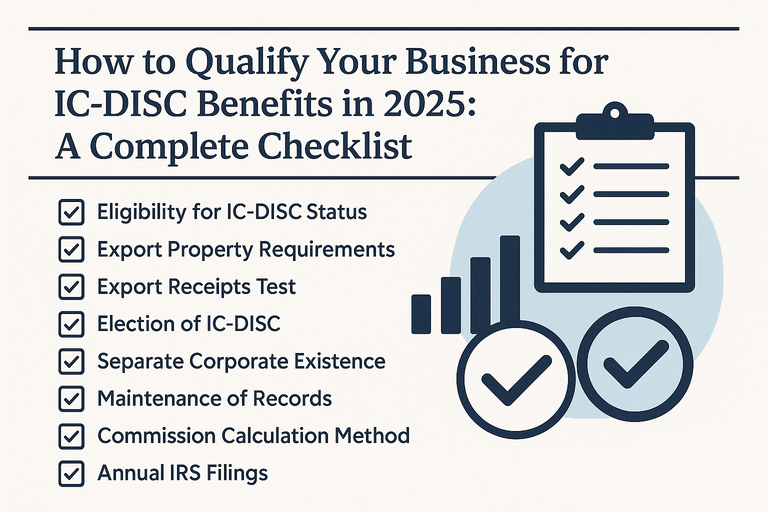
Step 1: Confirm Your Business Type and Ownership Structure
To qualify for IC-DISC benefits, your entity must be a
U.S. corporation (C-Corp, S-Corp, or LLC electing C-Corp treatment) formed under U.S. law. The IC-DISC itself must also be a
separate legal entity, with its own books and records, distinct from your operating company.
Each IC-DISC must:
- Be a U.S. domestic corporation.
- Maintain only one class of stock.
- Have at least $2,500 in capital stock.
To learn more about structural requirements, review
IC-DISC Qualification Criteria.
Step 2: Ensure Export Income Eligibility
At least
95% of the IC-DISC’s gross receipts and assets must be related to export activity. Export property includes goods manufactured, produced, grown, or extracted in the U.S. and sold for use outside the U.S.
Qualifying products and services typically include:
- Industrial machinery, equipment, and parts.
- Agricultural products.
- Software and technology licensed for foreign use.
For exporters in specialized industries such as software or aerospace, explore how
IC-DISC benefits for exporters can be applied to your business model.
Step 3: Establish Proper Recordkeeping and Documentation
Accurate documentation is critical for IC-DISC compliance. You must maintain:
- Detailed invoices showing export sales.
- Proof of foreign destination.
- Transfer pricing calculations supporting IC-DISC commission amounts.
Establishing a reliable documentation process not only ensures compliance but also prepares you for potential IRS review or audit. WTP Advisors outlines best practices in
How the IC-DISC Works.
Step 4: Set Up Commission Arrangements and Pricing Methods
The IC-DISC typically earns income through a
commission-based arrangement with the exporting company. The commission can be determined using one of several IRS-approved methods—most commonly:
- 4% of export gross receipts, or
- 50% of combined taxable income from export sales.
Businesses should test multiple pricing methods to identify which yields the highest allowable IC-DISC commission.
Step 5: File the IC-DISC Election and Maintain Annual Compliance
To activate IC-DISC status, you must file
Form 4876-A (Election to be Treated as an IC-DISC) with the IRS within 90 days of incorporation. Annual returns must also be filed on
Form 1120-IC-DISC.
Failing to maintain these filings can result in loss of IC-DISC status and significant tax exposure.
Step 6: Work with Experienced IC-DISC Advisors
Because IC-DISC rules intersect with transfer pricing, export compliance, and international tax, partnering with an experienced advisory firm like WTP Advisors ensures ongoing optimization and IRS readiness.
From setup to annual redetermination, expert guidance can significantly enhance the value of your IC-DISC strategy.
Final Thoughts
Qualifying for IC-DISC benefits in 2025 is more than checking boxes—it’s about building a sustainable export tax strategy. By confirming eligibility, maintaining documentation, and applying optimal pricing methods, your business can unlock substantial federal tax savings.