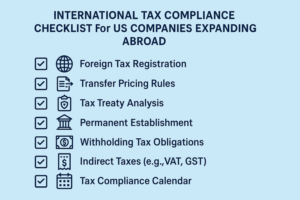
Expanding outside the United States isn’t just a growth move. It’s a compliance event.
Most US companies don’t get “hit” by international tax because they did something shady. They get hit because they moved fast—opened a bank account overseas, hired a contractor in another country, formed a subsidiary, started invoicing cross-border—and didn’t realize those actions trigger US reporting, foreign filings, withholding obligations, transfer pricing documentation, and permanent establishment risk.
This checklist is built for the first 90 days after you decide to go international. Use it to avoid the two expensive outcomes: (1) messy cleanup work, and (2) penalties and audit exposure that could’ve been avoided with basic hygiene.
If you want a broader overview of the international tax landscape, start here:
https://www.wtpadvisors.com/international-tax/
If you want help running the compliance workstream end-to-end, see:
https://www.wtpadvisors.com/international-tax-compliance/
If you’re still deciding
how to structure expansion, planning matters first:
https://www.wtpadvisors.com/international-tax-planning/
Why the “first 90 days” matter more than year-end
International tax compliance is path-dependent. The choices you make early become hard to unwind later:
- Entity type drives what returns and disclosures you must file.
- Intercompany flows determine withholding obligations and transfer pricing.
- Contract terms can create permanent establishment exposure.
- Who signs what, where decisions are made, and where work is performed can change your tax profile.
If you wait until tax season, you’ll be retroactively reconstructing facts—often inaccurately—which is exactly how companies walk into penalties.
The First 90 Days Checklist (Do this in order)
Phase 1 (Days 1–15): Confirm what you actually did (and what it triggers)
This phase is about facts. Not hopes. Not intentions.
1) List every cross-border action taken or planned
Include:
- New entities (subsidiary/branch/representative office)
- Foreign bank accounts
- Foreign employees/contractors
- Cross-border sales contracts
- Intercompany charges (management fees, royalties, cost sharing)
- Inventory storage or local warehousing
- Signing authority and where decisions are made
2) Identify whether you’re “inbound” or “outbound” (or both)
- Outbound: US company expanding abroad
- Inbound: foreign ownership or foreign group operating in the US
Mixing these up causes wrong filings and wrong planning assumptions.
3) Determine whether activities create permanent establishment (PE) risk
Common PE tripwires:
- Employees or dependent agents negotiating/closing contracts abroad
- Fixed place of business (office, warehouse, dedicated space)
- Local installation, services, or ongoing project work
If PE exists, you may have a local corporate tax filing obligation—even if you thought it was “just sales.”
Phase 2 (Days 16–45): Lock your structure + reporting map
This phase prevents “we formed something overseas and now we regret it.”
4) Confirm legal entity choices (subsidiary vs branch vs contractor model)
Different structures drive different compliance costs and different tax outcomes:
- Subsidiary may simplify PE concerns but increases reporting complexity.
- Branch can create direct foreign filing exposure in the parent’s name.
- Contractor models can still create PE if managed poorly.
5) Build a reporting obligations matrix
For each country + entity + activity, track:
- Corporate income tax return obligation
- VAT/GST registration needs
- Payroll withholding/social taxes
- Withholding on payments (royalties, services, dividends, interest)
- Statutory accounting/audit requirements
- Local transfer pricing documentation requirements
This matrix becomes your compliance operating system.
6) Confirm ownership percentages and entity classification for US purposes
This is where many companies accidentally trigger major US information returns. Ownership and classification drive whether certain US forms apply and what disclosures are required.
7) Set up governance: who approves intercompany agreements and pricing
If there’s no governance, intercompany transactions become “made up later,” which is exactly what auditors love to see.
Phase 3 (Days 46–75): Put transfer pricing and intercompany fundamentals in place
This phase is about alignment. If your operations and your paperwork disagree, you’re exposed.
8) Draft intercompany agreements early (not after the fact)
At minimum:
- Services (management/technical/support)
- IP licensing (if any software/brand/know-how is used cross-border)
- Cost allocations and reimbursements
- Sales/distribution arrangements
These aren’t “legal formalities.” They are audit evidence.
9) Choose a transfer pricing approach that matches reality
You need defensible answers to:
- Who owns the IP?
- Who performs the key functions?
- Who takes entrepreneurial risk?
- Where is value created?
- Who should earn routine vs residual profits?
Even if you’re not ready for a full study, you need a documented policy now to avoid chaos later.
10) Document your operational facts while they’re fresh
Capture:
- Where key leadership decisions are made
- Where contracts are negotiated and signed
- Where work is performed
- Where customer support happens
- What assets are located where
If you can’t prove it later, it didn’t happen (in the eyes of tax authorities).
Phase 4 (Days 76–90): Execute filing readiness + controls
This phase is about building repeatable compliance—so you don’t re-learn the same lesson every year.
11) Set up data capture for cross-border payments
You need clean tracking for:
- Vendor payments to foreign persons/entities
- Intercompany payments (service fees, royalties, interest)
- Dividend/distribution activity
- FX conversion and timing
Bad data turns compliance into forensic accounting.
12) Confirm withholding positions before money moves
Withholding is often triggered at payment time—not at year-end. If you get it wrong:
- you can owe tax you can’t recover from the payee,
- plus interest/penalties,
- plus reputational risk.
13) Align your finance close calendar to international deadlines
Some filings are due earlier than US returns. Some require local audited financials. If your US team closes books 30–45 days after period end, you may already be late somewhere else.
14) Decide whether you need ongoing support vs annual cleanup
If cross-border activity is recurring, annual “tax season only” support is a false economy. You want a workflow and owners, not heroics.
Common mistakes that get companies in trouble (so you can avoid them)
Here’s what I see repeatedly:
- “We only have a contractor” → contractor effectively acts like an employee/agent; PE risk is created.
- Intercompany charges start without agreements → transfer pricing becomes indefensible.
- Bank accounts opened without tracking signers → reporting surprises and messy disclosures.
- Withholding is ignored → the payer ends up eating the cost.
- Foreign filings are treated like US filings → different rules, different deadlines, different penalties.
What to do if you’re already past Day 90
Don’t pretend it’s fine. Do a rapid “backfill” sprint:
- Reconstruct activities and dates (entity formation, hires, first invoices, first payments).
- Identify high-risk gaps (withholding, PE exposure, missing intercompany terms).
- Fix forward with governance + documentation.
- Prioritize disclosures and late filings where penalties compound.
Practical takeaway
International expansion is not just a strategy decision—it’s a compliance system decision. If you don’t build the system early, you’ll pay for it later in penalties, audit risk, and operational drag.