What “withholding tax” means (in plain English)
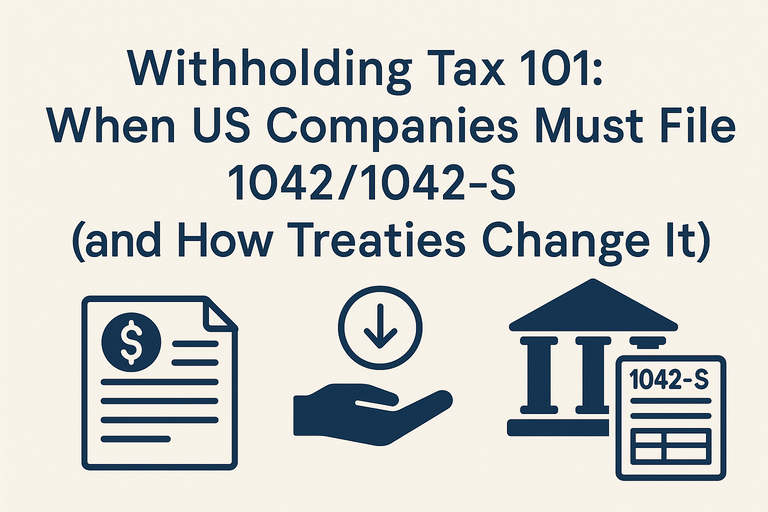
Withholding is the IRS saying:“If you pay certain types of US-source income to a foreign person, you must withhold tax and report it—unless an exception or treaty reduction applies.”The two big buckets that matter for most businesses:
- Payments to foreign persons that are subject to FDAP withholding (often a flat statutory rate unless reduced)
- Payments that might be connected to a US trade or business (a different analysis)
The core forms: 1042 and 1042-S (and why you should care)
If you make withholdable payments to foreign persons, you’re typically dealing with:- Form 1042: the annual withholding tax return (summary)
- Form 1042-S: the recipient statements/information returns (detail by payee/payment type)
When withholding commonly applies (the scenarios that trigger it)
US withholding often comes up when paying foreign persons for things like:1) Royalties and licensing
- software licenses
- IP, trademarks, know-how
- content licensing
2) Interest
- cross-border loans
- intercompany financing
- certain debt-like arrangements
3) Dividends or distributions
- payments from a US company to foreign shareholders
4) Certain service arrangements (this is where companies get sloppy)
Many companies assume: “Services = no withholding.” That assumption can be wrong depending on source rules, documentation, and facts.5) “Miscellaneous” cross-border payments that finance teams misclassify
Examples:- management fees
- consulting fees
- commission arrangements
- cost allocations
The documentation you need before you pay (or you’re guessing)
You should not be sending money to foreign vendors and then asking tax later, “So… was that withholdable?” A basic withholding workflow usually requires:- Payee identification: who are they (foreign person/entity)?
- Correct tax form from the payee (this is non-negotiable)
- Payment classification: what is being paid for?
- Treaty eligibility (if claimed): do they qualify, and is it documented?
- underwithhold → you may owe the tax + penalties
- overwithhold → you create vendor disputes and refund complexity
How tax treaties change withholding (and the trap people fall into)
Treaties can reduce (sometimes eliminate) withholding on certain types of income. That’s the upside. The trap: companies treat treaties like a magic coupon. Treaty benefits typically require:- the payee is eligible under the treaty
- the income type qualifies
- the right documentation is collected and retained
- the procedural rules are followed
The biggest mistakes (brutal but accurate)
Mistake #1: “AP pays it, tax reviews later”
That’s backwards. Withholding is determined before payment—because once you pay gross, you may not be able to claw back the withheld amount from the vendor.Mistake #2: Treating international payments like domestic 1099s
Wrong mental model. Different forms. Different rules. Different default rates. Different documentation.Mistake #3: Misclassifying royalties as “services” (or vice versa)
This is incredibly common in software and tech-enabled services.Mistake #4: No owner, no system
If withholding is “everyone’s job,” it’s nobody’s job. The result is inconsistent decisions and messy year-end filings.A practical “Withholding Readiness” checklist for your finance team
Use this as an internal control list:- Do we know whether the payee is US or foreign?
- Do we have the right payee documentation on file before payment?
- Have we classified the payment type correctly (royalty, service, interest, etc.)?
- Have we assessed whether withholding applies and at what rate?
- If a treaty rate is claimed, do we have support for treaty eligibility?
- Have we recorded withholding amounts properly in the ledger?
- Do we have a process to produce 1042-S data cleanly at year-end?
- Is there a reviewer/approver for exceptions?
How this fits into the bigger international tax picture
Withholding doesn’t live in isolation. It connects to:- transfer pricing and intercompany agreements
- contract drafting and pricing terms
- cash repatriation planning
- foreign tax credit positioning (depending on facts)
- audit risk and documentation standards