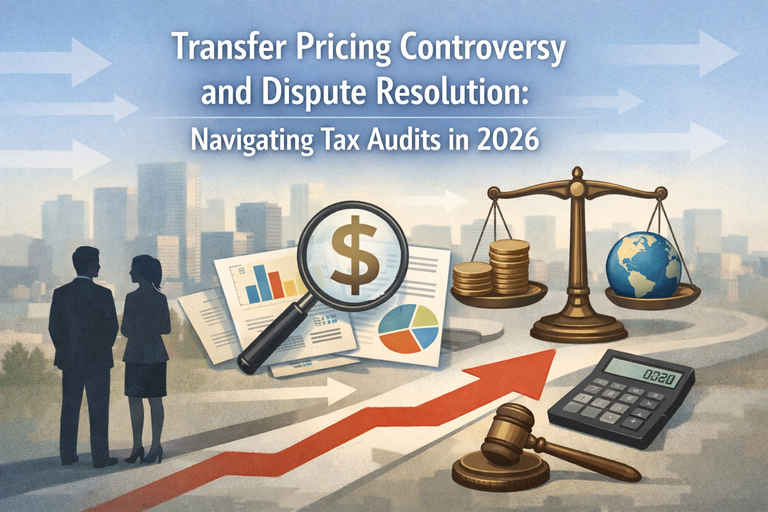
Transfer pricing remains the most significant tax risk area for multinational enterprises (MNEs), leading to frequent and often protracted disputes with tax authorities worldwide. As tax administrations become more sophisticated and collaborative, the likelihood of transfer pricing audits and controversies continues to rise. In 2026, MNEs must have robust strategies for managing transfer pricing disputes, including proactive measures to prevent them and effective mechanisms for resolution when they arise.
Understanding Transfer Pricing Controversy
Transfer pricing controversy typically begins with a tax audit, where tax authorities scrutinize an MNE’s intercompany transactions to ensure they comply with the arm’s length principle.
Common reasons for audit adjustments include:
- Inadequate Documentation Lack of comprehensive or consistent transfer pricing documentation (Master File, Local File, CbCR).
- Lack of Commercial Rationale Inability to demonstrate a clear business purpose for intercompany transactions.
- Comparability Issues Disagreements over the selection of comparable companies or transactions, or adjustments made to comparables.
- Functional Analysis Disputes Different interpretations of the functions performed, assets used, and risks assumed by associated enterprises.
- Valuation of Intangibles High subjectivity and complexity in valuing intellectual property, leading to disputes over royalty rates or IP transfers.
- Year-End Adjustments Challenges by customs authorities on transfer pricing adjustments made after the goods have been imported.
Mechanisms for Dispute Resolution
When a transfer pricing dispute arises, MNEs have several avenues for resolution:
- Mutual Agreement Procedure (MAP) The MAP is a process under bilateral tax treaties where competent authorities of the contracting states endeavor to resolve disputes regarding the interpretation or application of the treaty, including transfer pricing adjustments. If an MNE faces double taxation due to a transfer pricing adjustment in one country, it can request a MAP to seek relief. The OECD’s BEPS Action 14 has significantly enhanced the effectiveness of MAPs.
- Advance Pricing Agreements (APAs) APAs are agreements between an MNE and one or more tax authorities that determine, in advance of intercompany transactions, an appropriate set of transfer pricing criteria (e.g., methods, comparables, critical assumptions) for a specified period. APAs provide certainty and prevent disputes by locking in an arm’s length outcome. They can be unilateral (with one tax authority), bilateral (with two tax authorities), or multilateral (with multiple tax authorities).
- Arbitration Some tax treaties include provisions for arbitration, which can be used if competent authorities fail to reach an agreement through MAP within a specified timeframe. Arbitration provides a binding resolution to the dispute.
- Litigation As a last resort, MNEs may pursue litigation in national courts to challenge transfer pricing adjustments. This is often a lengthy and costly process.
Proactive Strategies for Risk Mitigation in 2026
To minimize transfer pricing controversy, MNEs should adopt a proactive approach:
- Robust Documentation Maintain comprehensive, consistent, and up-to-date transfer pricing documentation that clearly supports the arm’s length nature of all intercompany transactions.
- Strong Commercial Rationale Ensure that all intercompany transactions have a clear commercial rationale that aligns with the MNE’s business strategy.
- Regular Review and Benchmarking Periodically review transfer pricing policies and conduct benchmarking studies to ensure they remain aligned with market conditions and regulatory expectations.
- Early Engagement with Tax Authorities Consider engaging with tax authorities through cooperative compliance programs or by seeking APAs for complex or high-value transactions.
- Internal Dispute Resolution Establish internal processes for identifying and resolving potential transfer pricing issues before they escalate to external disputes.
- Cross-Functional Collaboration Foster collaboration between tax, legal, finance, and business units to ensure a consistent approach to transfer pricing across the organization.
FAQs on Transfer Pricing Controversy and Dispute Resolution
Q1: What are the most common reasons for transfer pricing audit adjustments?
A1: Common reasons for transfer pricing audit adjustments include inadequate or inconsistent documentation, lack of clear commercial rationale for intercompany transactions, disputes over the selection or application of comparable data, differing interpretations of functional analyses, and the complex valuation of intangible assets. Tax authorities often challenge MNEs on these points to argue for higher taxable profits.
Q2: How does a Mutual Agreement Procedure (MAP) help resolve transfer pricing disputes?
A2: A MAP is a process under bilateral tax treaties where the competent authorities of two countries work together to resolve disputes regarding the interpretation or application of the treaty, including transfer pricing adjustments. Its primary goal is to eliminate double taxation that can arise when one country makes a transfer pricing adjustment that is not accepted by the other country.
Q3: What are the benefits of an Advance Pricing Agreement (APA)?
A3: The main benefits of an APA are increased tax certainty and dispute prevention. By agreeing in advance with tax authorities on an appropriate transfer pricing methodology for specific intercompany transactions over a defined period, MNEs can significantly reduce the risk of future audits, adjustments, and double taxation. APAs can be unilateral, bilateral, or multilateral.
Q4: When should an MNE consider litigation for a transfer pricing dispute?
A4: Litigation should generally be considered a last resort for transfer pricing disputes, as it is often a lengthy, costly, and public process. MNEs typically explore all other dispute resolution mechanisms, such as MAPs and APAs, before resorting to national courts. Litigation may be pursued when other avenues have failed and the MNE believes it has a strong legal case.
Q5: What proactive steps can MNEs take to minimize transfer pricing controversy in 2026?
A5: To minimize controversy, MNEs should maintain robust and up-to-date transfer pricing documentation, ensure a strong commercial rationale for all intercompany transactions, regularly review and benchmark their policies, consider early engagement with tax authorities through cooperative compliance or APAs, and foster cross-functional collaboration within the organization to ensure consistency and compliance.