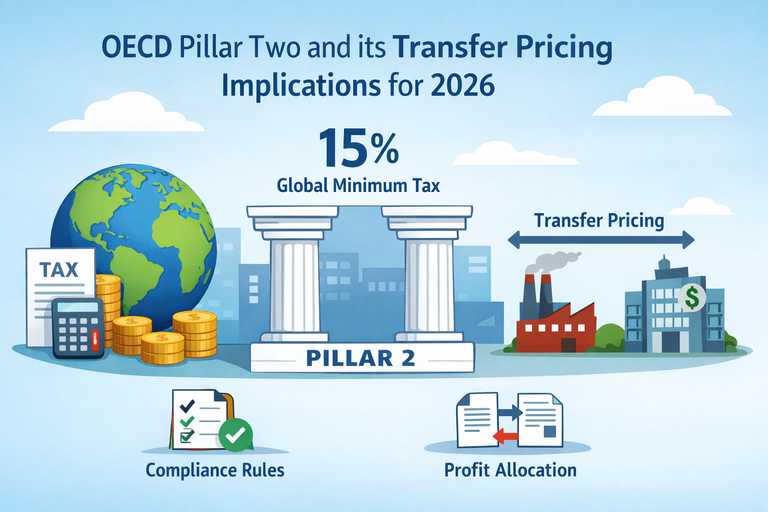
The global tax landscape is undergoing a significant transformation with the implementation of the OECD’s Pillar Two initiative, also known as the Global Anti-Base Erosion (GloBE) rules. These rules aim to ensure that multinational enterprises (MNEs) pay a minimum effective tax rate of 15% on their profits in every jurisdiction where they operate. While primarily focused on corporate income tax, Pillar Two has profound implications for transfer pricing strategies and compliance, particularly as we approach 2026.
Understanding Pillar Two and its Interaction with Transfer Pricing
Pillar Two introduces a new layer of complexity for MNEs. The core mechanisms are the Income Inclusion Rule (IIR) and the Undertaxed Profits Rule (UTPR), which allocate top-up tax to ensure the 15% minimum. The calculation of the effective tax rate (ETR) under Pillar Two relies on financial accounting net income, adjusted for specific tax items. This ETR calculation can be significantly influenced by transfer pricing outcomes, as intercompany transactions directly impact the allocation of profits and expenses across jurisdictions.
For instance, if transfer pricing policies result in profits being shifted to low-tax jurisdictions, and the ETR in those jurisdictions falls below 15%, Pillar Two mechanisms will kick in, potentially leading to additional tax liabilities in other jurisdictions. This necessitates a closer alignment between transfer pricing policies and Pillar Two compliance, moving beyond the traditional arm’s length principle to consider the overall effective tax rate.
Key Implications for Transfer Pricing Documentation and Strategy
- Increased Scrutiny of Profit Allocation Tax authorities will have an additional lens through which to scrutinize profit allocation. Transfer pricing documentation will need to demonstrate not only arm’s length compliance but also how the chosen methodologies align with the MNE’s overall ETR and Pillar Two obligations. This may require MNEs to re-evaluate their transfer pricing models to minimize top-up tax liabilities.
- Data and Systems ChallengesPillar Two requires extensive data collection and aggregation at a granular level, often beyond what is typically required for traditional transfer pricing documentation. MNEs will need robust systems to capture and process financial and tax data from all entities to accurately calculate ETRs and potential top-up taxes. This includes data related to intercompany transactions, which are central to transfer pricing.
- Impact on Intangibles and Services The valuation and allocation of profits related to intangibles and intercompany services, often complex areas in transfer pricing, will come under renewed focus. MNEs will need to ensure that the pricing of these transactions does not inadvertently trigger Pillar Two top-up taxes in certain jurisdictions.
- Safe Harbors and Simplifications The OECD has introduced transitional safe harbors, such as the Transitional Country-by-Country Reporting (CbCR) Safe Harbor, which can temporarily reduce the compliance burden. However, these are temporary measures, and MNEs must prepare for the full implementation of Pillar Two. Understanding how transfer pricing data feeds into these safe harbor calculations is crucial.
- Dispute Resolution The interaction between Pillar Two and existing transfer pricing rules may lead to new areas of tax controversy. MNEs should proactively assess their risk exposure and consider mechanisms for dispute prevention and resolution, such as Advance Pricing Agreements (APAs), which may need to incorporate Pillar Two considerations.
Preparing for 2026 and Beyond
To navigate the evolving landscape, MNEs should:
- Assess Impact Conduct a comprehensive assessment of how Pillar Two will impact their current transfer pricing policies and overall tax position.
- Enhance Data Capabilities Invest in technology and processes to collect, analyze, and report the necessary data for Pillar Two and transfer pricing compliance.
- Review Transfer Pricing Policies Re-evaluate existing transfer pricing methodologies and consider adjustments to optimize ETRs and minimize top-up taxes.
- Engage with Experts Seek advice from transfer pricing and international tax specialists to develop a robust strategy and ensure compliance.
FAQs on OECD Pillar Two and Transfer Pricing
Q1: What is the primary goal of OECD Pillar Two, and how does it relate to transfer pricing?
A1: The primary goal of OECD Pillar Two is to ensure large multinational enterprises pay a minimum effective tax rate of 15% on their profits globally. It relates to transfer pricing because intercompany transactions, governed by transfer pricing rules, directly influence where profits are recorded, which in turn affects the effective tax rate calculation in each jurisdiction under Pillar Two. Inconsistent transfer pricing can trigger top-up taxes.
Q2: How will Pillar Two affect the traditional arm’s length principle in transfer pricing?
A2: While Pillar Two does not replace the arm’s length principle, it adds an additional layer of consideration. MNEs must now ensure their arm’s length transfer pricing outcomes do not inadvertently lead to an effective tax rate below 15% in any jurisdiction, triggering top-up taxes. This means transfer pricing strategies must be viewed through both an arm’s length and a minimum tax lens.
Q3: What kind of data challenges can MNEs expect with Pillar Two and transfer pricing?
A3: MNEs can expect significant data challenges, as Pillar Two requires granular financial and tax data from all entities to calculate effective tax rates. This often goes beyond the data typically gathered for transfer pricing documentation. Companies will need robust systems to aggregate profit and loss data, covered taxes, and intercompany transaction details across all jurisdictions to ensure accurate Pillar Two calculations.
Q4: Are there any safe harbors available to ease the compliance burden?
A4: Yes, the OECD has introduced transitional safe harbors, such as the Transitional CbCR Safe Harbor, which can temporarily reduce the compliance burden for MNEs that meet certain criteria. However, these are temporary, and MNEs should use this time to prepare for the full implementation of Pillar Two and its ongoing data and reporting requirements.
Q5: How should MNEs adjust their transfer pricing strategy in light of Pillar Two for 2026?
A5: MNEs should conduct an impact assessment of Pillar Two on their current transfer pricing policies, enhance their data collection and reporting capabilities, review and potentially adjust their transfer pricing methodologies to optimize ETRs, and engage with tax specialists to develop a comprehensive compliance strategy for 2026 and beyond.