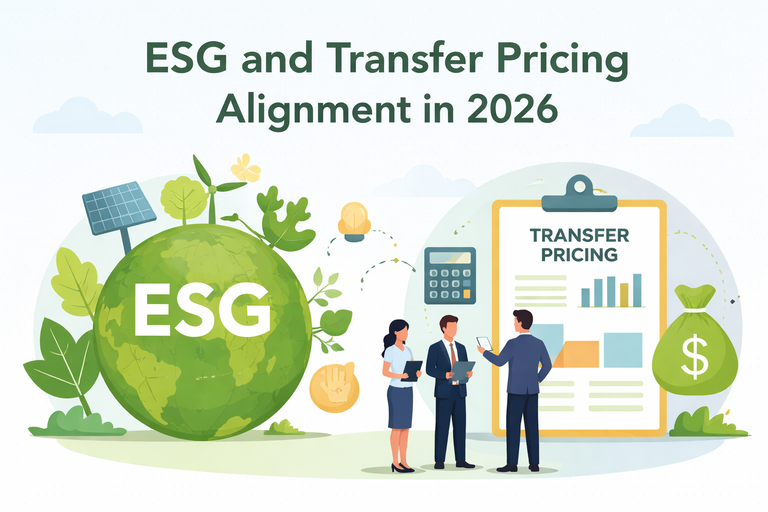
The growing emphasis on Environmental, Social, and Governance (ESG) factors is reshaping corporate strategies and operations across industries. While ESG initiatives are often viewed through the lens of sustainability, corporate responsibility, and investor relations, their implications for tax—and specifically transfer pricing—are becoming increasingly significant. In 2026, multinational enterprises (MNEs) must proactively consider how their ESG commitments intersect with their transfer pricing policies to ensure compliance, manage risks, and align with evolving regulatory expectations.
The Interplay Between ESG and Transfer Pricing
ESG factors can influence transfer pricing in several ways, primarily by impacting the functions performed, assets employed, and risks assumed by various entities within an MNE group. This, in turn, affects the arm’s length pricing of intercompany transactions.
- Environmental Initiatives MNEs investing in sustainable production methods, renewable energy, or carbon reduction technologies may incur significant costs or generate new intellectual property (IP). The allocation of these costs and the pricing of intercompany services related to environmental initiatives (e.g., environmental consulting, green technology development) need careful transfer pricing consideration. For example, if a central entity develops green technology, the licensing or sale of this IP to other group entities must be at arm’s length.
- Social Considerations Fair labor practices, diversity and inclusion programs, and community engagement can influence an MNE’s reputation and brand value. While harder to quantify directly in transfer pricing, these social factors can indirectly impact the value of marketing intangibles or the cost of labor, which are relevant in functional analyses and benchmarking studies. For instance, a strong social reputation might justify higher margins for certain branded products.
- Governance Structures Robust governance frameworks, including ethical supply chain management and anti-corruption measures, are crucial for ESG compliance. These governance efforts often involve centralized functions (e.g., compliance departments, internal audit) that provide services to other group entities. The pricing of these intercompany governance services must be consistent with the arm’s length principle, considering the value they add and the costs incurred.
Emerging Transfer Pricing Challenges and Opportunities
- Valuation of ESG-Related Intangibles As MNEs develop proprietary ESG-related technologies, processes, or brands, the valuation and transfer pricing of these intangibles will become a critical area. This includes patents for sustainable manufacturing, trademarks associated with eco-friendly products, or proprietary data analytics for ESG reporting.
- Cost Contribution Arrangements (CCAs) for ESG Initiatives MNEs may enter into CCAs to jointly develop or implement ESG initiatives. The transfer pricing aspects of these arrangements, including the allocation of costs and benefits among participants, need to be clearly defined and documented.
- Supply Chain Resilience and ESG ESG considerations are driving MNEs to re-evaluate and restructure their supply chains, often favoring local sourcing or more resilient networks. These restructurings have direct transfer pricing implications, as changes in supply chain models alter the allocation of functions, assets, and risks among group entities.
- ESG Reporting and Transparency Increased regulatory requirements for ESG reporting may necessitate greater transparency in transfer pricing policies, especially regarding how intercompany transactions contribute to or are impacted by ESG objectives. Tax authorities may begin to scrutinize transfer pricing documentation for alignment with public ESG statements.
Best Practices for MNEs in 2026
To effectively integrate ESG into transfer pricing, MNEs should:
- Conduct an ESG-Transfer Pricing Impact Assessment Identify how current and planned ESG initiatives affect intercompany transactions, functional profiles, and risk allocations.
- Update Functional Analyses Ensure that functional analyses accurately reflect ESG-related activities, assets, and risks, including the development of green technologies or the provision of compliance services.
- Review Intercompany Agreements Modify or create intercompany agreements to clearly define the roles, responsibilities, and remuneration for ESG-related activities within the MNE group.
- Enhance Documentation Prepare robust transfer pricing documentation that explains how ESG factors have been considered in the pricing of intercompany transactions and how they align with the arm’s length principle.
- Monitor Regulatory Developments Stay abreast of evolving ESG reporting standards and tax authority guidance on the intersection of ESG and transfer pricing.
FAQs on ESG and Transfer Pricing Alignment
Q1: How do environmental initiatives impact transfer pricing?
A1: Environmental initiatives can impact transfer pricing by generating new costs (e.g., for sustainable production), creating new intellectual property (e.g., green technologies), or influencing supply chain structures. The allocation of these costs, the pricing of intercompany services related to environmental efforts, and the valuation of green IP must all adhere to arm’s length principles.
Q2: Can social factors, like fair labor practices, directly influence transfer pricing?
A2: While social factors like fair labor practices are not directly priced in intercompany transactions, they can indirectly influence transfer pricing. For example, a strong commitment to social responsibility can enhance an MNE’s brand value, which might be a factor in the valuation of marketing intangibles. Additionally, the costs associated with implementing social programs need to be appropriately allocated and remunerated if they are provided as intercompany services.
Q3: What are the transfer pricing considerations for centralized governance functions related to ESG?
A3: Centralized governance functions, such as compliance, risk management, or internal audit, often provide services to various entities within an MNE group to ensure ESG adherence. The transfer pricing consideration here is to ensure that these intercompany services are priced at arm’s length, reflecting the costs incurred and the value provided to the recipient entities. Proper service agreements and cost allocation methodologies are essential.
Q4: How does ESG reporting affect transfer pricing documentation?
A4: Increased ESG reporting and transparency requirements may lead tax authorities to scrutinize transfer pricing documentation more closely for consistency with an MNE’s public ESG statements. MNEs may need to enhance their documentation to explain how ESG factors have been considered in their transfer pricing policies and how intercompany transactions align with their broader ESG objectives.
Q5: What is the role of Cost Contribution Arrangements (CCAs) in ESG-related transfer pricing? A5: CCAs can be used by MNEs to jointly fund and share the risks and benefits of developing or implementing ESG initiatives, such as new sustainable technologies or shared environmental programs. From a transfer pricing perspective, it’s crucial to ensure that the CCA is structured at arm’s length, with clear rules for cost allocation, participant contributions, and the sharing of expected benefits, to avoid challenges from tax authorities.