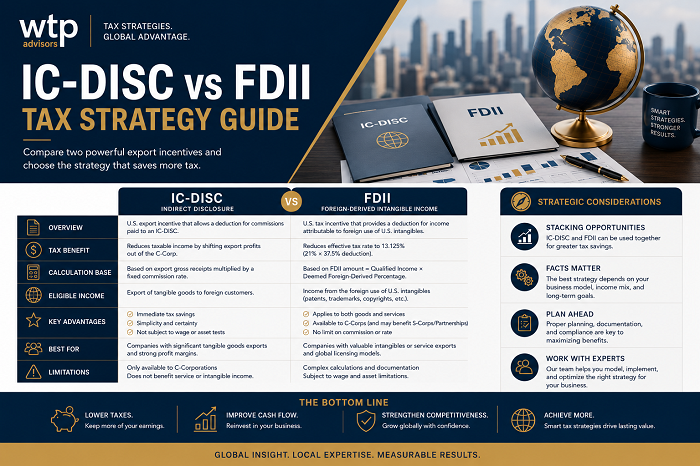
The IC-DISC works through a commission structure. The operating exporter pays a commission to the IC-DISC entity — calculated using either a 4% of qualified export receipts formula or a 50% of combined taxable income formula, whichever is greater. The IC-DISC deducts this commission, the operating company deducts it as a business expense, and the IC-DISC pays it out to shareholders as a qualified dividend.
The net tax effect is a conversion of ordinary income (taxed up to 37%) into qualified dividend income (taxed at 15–20% for most shareholders, plus net investment income tax). For a shareholder paying a 37% ordinary rate and a 23.8% qualified dividend rate, every $1 million in IC-DISC commissions produces approximately $132,000 in annual federal tax savings.
WHO CAN USE IC-DISC
C-corporations, S-corporations, partnerships, and LLCs taxed as pass-throughs — as long as the operating entity generates qualifying export receipts under the IRC §992 rules. The IC-DISC itself must always be organized as a C-corporation.
What Is FDII?
FDII (Foreign-Derived Intangible Income)
A U.S. tax deduction under IRC §250, available exclusively to domestic C-corporations, that reduces taxable income on foreign-derived income from sales, services, or licenses provided to foreign persons or for foreign use. The deduction effectively lowers the federal corporate tax rate on qualifying income to approximately 13.125% (using a 37.5% deduction against the 21% corporate rate).
Unlike IC-DISC, FDII does not require any separate entity, commission structure, or election. It is calculated directly on the C-corporation’s tax return based on the ratio of foreign-derived deduction-eligible income (FDDEI) to total deduction-eligible income (DEI), applied to the corporation’s excess profits above a 10% return on qualified business asset investment.
In practical terms, FDII benefits companies whose income already flows through a C-corporation structure and who sell goods, provide services, or license intangibles to foreign customers — without requiring any change to how the company operates.
CRITICAL RESTRICTION
FDII is available only to domestic C-corporations. S-corporations, partnerships, LLCs taxed as pass-throughs, and individuals cannot claim the FDII deduction under any circumstances. For these entity types, IC-DISC is the only export tax incentive available at the federal level.
IC-DISC vs FDII: Core Structural Differences
Both incentives reward export activity, but they operate through fundamentally different mechanisms. Understanding this difference is the starting point for any planning analysis.
| Feature |
IC-DISC |
FDII |
| Legal basis |
IRC §992–997 |
IRC §250 |
| Mechanism |
Commission to separate entity; income distributed as qualified dividends |
Direct deduction on the C-corporation’s tax return |
| Entity required? |
Yes — a separate domestic IC-DISC corporation |
No — claimed on existing corporate return |
| Who qualifies |
C-corps, S-corps, partnerships, LLCs (operating entity) |
Domestic C-corporations only |
| Revenue types |
Qualified export property (physical goods); qualifying services |
Goods, services, licenses, intangibles to foreign persons |
| Tax benefit type |
Rate conversion: ordinary income → qualified dividend rates |
Deduction: reduces taxable income on qualifying foreign revenue |
| Setup complexity |
Moderate — entity formation, election, annual compliance |
Low — calculated on existing corporate return |
| Compliance burden |
Annual Form 1120-IC-DISC; commission docs; asset & receipts tests |
FDII calculation on Form 8993; no separate entity |
| Deferral available? |
Yes — limited deferral with interest charge |
No deferral — current-year deduction only |
| Best suited for |
Manufacturers; pass-through exporters; physical goods |
Large C-corps; service/digital exporters; compliance simplicity |
When IC-DISC Is the Better Choice
IC-DISC produces more favorable outcomes than FDII in four primary situations.
1. Your operating entity is not a C-corporation
If the exporting business is organized as an S-corporation, partnership, or LLC taxed as a pass-through, IC-DISC is the only federal export tax incentive available. FDII is not accessible to these entity types under any circumstances. For pass-through exporters — which include many family-owned manufacturers, agricultural exporters, and closely-held distribution businesses — IC-DISC is the default planning tool.
2. Your exports are primarily physical goods
IC-DISC commission calculations are structured around qualified export receipts and combined taxable income from the sale of qualifying export property — generally, tangible goods manufactured, produced, grown, or extracted in the United States and sold for use outside the U.S. Manufacturers, distributors, agricultural producers, and industrial equipment exporters consistently find IC-DISC mechanics favorable for goods-based revenue streams.
3. The dividend rate differential produces meaningful savings
IC-DISC converts ordinary income to qualified dividends. For shareholders at the 37% federal rate receiving qualified dividends taxed at 23.8% (20% + 3.8% NIIT), the rate conversion produces savings of $132,000 per $1 million in commission income. When shareholder rates are lower — or when shareholders are corporations rather than individuals — this differential narrows and the IC-DISC advantage diminishes.
4. You want deferral in addition to rate savings
IC-DISC allows a limited deferral of income — the IC-DISC can accumulate income rather than distributing it immediately, subject to an annual interest charge on the deferred amount. This provides a timing benefit in addition to the rate conversion. FDII provides no equivalent deferral mechanism.
KEY SIGNAL FOR IC-DISC
If your business is a pass-through entity or exports physical goods with stable margins above 10%, IC-DISC almost always deserves a detailed analysis — the upfront setup cost is typically recovered in the first year’s savings. Businesses evaluating export tax incentives should also review official IRS guidance for Form 1120-IC-DISC.
When FDII Is the Better Choice
FDII outperforms IC-DISC — or is clearly preferable on a cost-benefit basis — in three primary situations.
1. Your company is a large C-corporation with service or digital exports
FDII is particularly well-suited to C-corporations that sell software, SaaS subscriptions, digital content, consulting services, engineering services, or license intangible property to foreign customers. These revenue types qualify for FDII treatment and often do not translate well to IC-DISC commission structures. A domestic C-corporation with $10 million in foreign subscription revenue may find FDII produces a larger and simpler benefit than IC-DISC without the administrative overhead of maintaining a separate entity.
2. Entity restructuring is not feasible
IC-DISC requires the creation and maintenance of a separate corporate entity. For companies with complex ownership structures, institutional investors with restrictions on subsidiary formation, or foreign shareholders who would not benefit from the qualified dividend treatment, IC-DISC entity creation can be impractical or cost-ineffective. FDII requires no new entity and is claimed directly on the existing corporate return.
3. Compliance simplicity is a priority
FDII’s compliance burden is meaningfully lower than IC-DISC. Claiming FDII requires calculating the deduction on Form 8993 and attaching it to the corporate return — no separate entity, no commission agreement documentation, no annual receipts and assets tests, and no separate tax return filing. For smaller C-corporations or those with limited internal tax resources, this simplicity has real value.
FDII RATE RISK
The FDII deduction rate was scheduled to decrease under TCJA’s sunset provisions after 2025 — from a 37.5% deduction (producing a ~13.1% effective rate) to a 21.875% deduction (producing a ~16.4% effective rate). Any FDII analysis should model both the current and reduced-rate scenarios to understand downside planning risk.
Real-World Scenario Comparison
The following scenarios illustrate how the IC-DISC vs FDII decision plays out in practice. These are illustrative examples — actual outcomes require detailed modeling using company-specific figures.
SCENARIO 1
Manufacturing Exporter — S-Corporation
Profile: $12M in qualifying export receipts from industrial equipment; 35% combined taxable income margin; two individual shareholders at the 37% ordinary rate; pass-through entity structure.
IC-DISC: Commission of approximately $2.1M using the 50% combined taxable income method. Tax savings at 37% vs 23.8% rate differential: approximately $277,000 annually.
FDII: Not available. S-corporations cannot claim the FDII deduction.
Result: IC-DISC by default. Pass-through structure eliminates FDII as an option. IC-DISC produces significant savings that more than justify the annual compliance cost.
SCENARIO 2
SaaS Company — C-Corporation
Profile: $15M in total revenue; $9M from foreign subscription customers; primarily software sold to businesses outside the U.S.; organized as a C-corporation with institutional equity investors who restrict subsidiary formation.
IC-DISC: Limited applicability — SaaS revenue may partially qualify, but IC-DISC rules for services are restrictive and the investor restriction prevents forming the required IC-DISC entity.
FDII: Assuming $9M qualifies as foreign-derived income, FDII deduction reduces effective federal rate on qualifying income to approximately 13.1%, producing material tax savings.
Result: FDII clearly preferable. Investor restrictions prevent IC-DISC entity formation; FDII is directly accessible and well-suited to foreign subscription revenue.
SCENARIO 3
Mixed Exporter — C-Corporation (Goods + Services)
Profile: $20M in export revenue — $13M from manufactured goods, $7M from foreign engineering and installation services; C-corporation with individual shareholders; no investor restrictions.
IC-DISC: Strong benefit on the $13M goods revenue using the 50% combined taxable income commission method. Services may qualify depending on classification.
FDII: Both goods and services revenue may qualify for FDII treatment if provided to foreign persons for foreign use — potentially applicable to the full $20M revenue base.
Result: Requires detailed modeling. This profile may benefit from IC-DISC on the goods component and FDII on qualifying services — or IC-DISC alone if commission calculations produce larger savings. A combined analysis is required before implementation.
The Most Common Decision Mistakes
Most exporters who fail to optimize their IC-DISC or FDII position make one of the following errors.
| Mistake |
Why It Costs Money |
| Defaulting to FDII without checking entity type |
FDII is unavailable to S-corps and partnerships — companies discover this at filing and have no IC-DISC in place |
| Assuming IC-DISC is only for manufacturers |
Agricultural exporters, distributors, and some service companies qualify — missed analysis means missed savings |
| Choosing based on headline tax rate, not modeled outcomes |
IC-DISC and FDII interact differently with ownership structure, state taxes, and dividend policy |
| Not evaluating both strategies annually |
Revenue mix, margins, and tax rates change — a strategy suboptimal three years ago may now be optimal |
| Treating setup complexity as a disqualifier |
IC-DISC compliance costs $5,000–$15,000 annually; for $5M+ export companies, savings exceed this by 10–20x |
| Waiting until after year-end to decide |
IC-DISC must be elected before the tax year begins; waiting eliminates the option regardless of how favorable the analysis looks |
How to Choose Between IC-DISC and FDII: Step-by-Step
A proper IC-DISC vs FDII evaluation follows a structured sequence. Skipping steps — or making the decision based on a single factor — consistently leads to suboptimal outcomes.
Step 1: Confirm entity eligibility first
Determine your operating entity type. If you are organized as an S-corporation, partnership, or LLC taxed as a pass-through, FDII is not available — proceed directly to IC-DISC analysis. If you are a C-corporation, both strategies require comparative modeling.
Step 2: Classify and quantify your qualifying export revenue
Identify the dollar volume and type of your qualifying export income — physical goods, services, digital products, licensed intangibles. IC-DISC and FDII have different qualifying income definitions. Revenue that qualifies for one may not fully qualify for the other.
Step 3: Model IC-DISC commission savings using both calculation methods
For IC-DISC, calculate commissions under both the 4% of qualified export receipts method and the 50% of combined taxable income method. The greater of the two is the maximum allowable commission. Apply the applicable ordinary income and dividend rates to quantify annual savings net of the IC-DISC interest charge.
Step 4: Model FDII savings on the same revenue base
For FDII, calculate the deduction amount using the Form 8993 methodology. Apply the 21% corporate rate to the net income after the deduction. Account for the potential sunset reduction in the deduction rate when projecting multi-year savings.
Step 5: Net the compliance cost against each strategy’s savings
IC-DISC requires annual entity maintenance, commission documentation, and a separate tax return — typically $5,000 to $20,000 annually. Subtract this from IC-DISC savings to get the net benefit. FDII compliance adds minimal incremental cost to the corporate return.
Step 6: Make and implement the decision before year-end
IC-DISC elections must be filed within 90 days of the start of the corporation’s tax year. The IC-DISC entity must exist and be operational before the tax year for which benefits are claimed. Neither strategy can be retroactively applied to a closed tax year.
Why Timing Determines How Much You Save
The most consistent reason U.S. exporters leave IC-DISC and FDII savings on the table is not analytical failure — it is late-start planning. Both strategies require decisions and actions that must occur before specific deadlines.
For IC-DISC, the entity must be formed and the election filed before the tax year begins. A company that decides to implement IC-DISC in February for a calendar-year entity has already forfeited the current year’s benefit. The structural decision must be made in advance — before the tax year opens.
For FDII, no pre-year election is required, but revenue contracts, cost allocations, and intercompany pricing arrangements that affect the FDII calculation should be reviewed and confirmed before year-end, not reconstructed at filing.
PLANNING TIMELINE
Both IC-DISC and FDII analysis should begin by Q3 of each tax year — not at year-end, and certainly not at filing. For IC-DISC new implementations, Q2 or Q3 of the year prior is the appropriate starting point for analysis, entity formation, and election filing.
Compliance and Audit Risk for Each Strategy
Both IC-DISC and FDII are established, IRS-sanctioned incentives — neither is aggressive tax planning. However, both carry specific compliance obligations that, if not met, can result in partial or full disallowance of benefits.
IC-DISC Compliance Requirements
The IC-DISC must pass two annual qualification tests: the 95% qualified export receipts test and the 95% qualified export assets test. The commission paid to the IC-DISC must be calculated using a permissible method and documented in a commission agreement that predates the transactions it covers. Failure to maintain these records or pass these tests can result in disqualification of the IC-DISC for the affected year.
FDII Compliance Requirements
FDII requires documentation that the income qualifies as foreign-derived — meaning it comes from sales to foreign persons for foreign use or from services provided to foreign persons or with respect to property located outside the U.S. The IRS has indicated that FDII qualification documentation is an area of examination focus. Revenue that cannot be properly documented as foreign-derived does not qualify for the deduction.