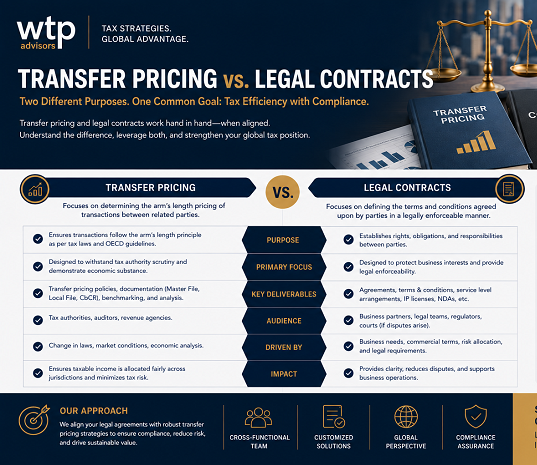
Transfer Pricing Policy
The methodology and documentation framework that determines how intercompany transactions should be priced to reflect arm’s-length market conditions. Transfer pricing policy establishes substance — it governs how profit and risk are actually allocated across entities based on economic functions performed, risks assumed, and assets owned. The OECD Transfer Pricing Guidelines provide the internationally recognized framework for applying the arm’s-length standard.
Why Tax Authorities Go Beyond the Contract
Tax authorities — including the IRS, HMRC, and equivalents in OECD jurisdictions — do not accept intercompany contracts at face value. Their examination focuses on three dimensions:
| What the Contract Says |
What Auditors Actually Examine |
- Entity is a ‘limited risk distributor’
- Parent provides management services for 3% fee
- IP license granted for 1.5% royalty
- Risk borne by foreign subsidiary
- Services delivered by specific entity
|
- Does entity actually bear market and credit risk?
- Are services consistently performed and invoiced?
- Is royalty rate supported by benchmarking?
- Does substance (staff, assets) support risk assumption?
- Are services documented and invoices contemporaneous?
|
AUDIT STANDARD
The OECD Transfer Pricing Guidelines are explicit: contracts will be disregarded or recharacterized when they are inconsistent with the actual conduct of the parties. Economic substance — not legal form — determines the tax outcome.
Most Common Contract vs. Reality Mismatches
The following scenarios are the most frequently identified mismatches in transfer pricing audits of intercompany agreements:
#A
Contract says ‘limited risk distributor’ — entity bears market risk
Issue: The intercompany agreement characterizes a foreign subsidiary as a limited risk entity with capped returns. In practice, the entity negotiates contracts, absorbs bad debts, and bears inventory and currency risk.
Risk: Tax authorities recharacterize as a full-risk distributor, reallocate profits, and may assess penalties for incorrect characterization.
#B
Service agreement exists — but services are not delivered
Issue: Management service agreements exist between the parent and subsidiaries. However, no services are consistently performed, invoices are not issued, and no documentation of service delivery exists.
Risk: The IRS or HMRC disallows the service fee deduction, creates a deemed distribution, or recharacterizes as a hidden profit transfer.
#C
IP license in place — but no royalty payments occur
Issue: An intellectual property license grants rights from a parent to a subsidiary. No royalty payments have been made for two or more tax years. The subsidiary uses the IP commercially.
Risk: Tax authorities characterize the royalty-free use as an implicit transfer of value, impose imputed royalties at arm’s-length rates, and assess back taxes and interest.
The Legal Form vs. Economic Substance Rule
The fundamental principle governing this area is straightforward:
GOVERNING PRINCIPLE
Tax outcome = Economic substance, not legal form alone. A contract that accurately reflects the legal relationship but does not match economic reality provides no audit protection. Tax authorities will restructure or disregard agreements that contradict actual business operations, functional responsibilities, and profit-sharing behavior.
This means intercompany agreements must do three things simultaneously:
- Accurately describe the legal relationship between entities
- Reflect the actual economic functions, risks, and assets of each party
- Align with the transfer pricing methodology and benchmarking data used to price the transaction