Why Intercompany Agreements Are the First Audit Checkpoint

In a transfer pricing audit, tax authorities do not begin by reviewing financial models or benchmarking studies. They begin by requesting intercompany agreements. Agreements function as the auditor’s roadmap — they reveal whether a company has documented its related-party transactions, whether those documents are current, and whether they are consistent with how the business actually operates.
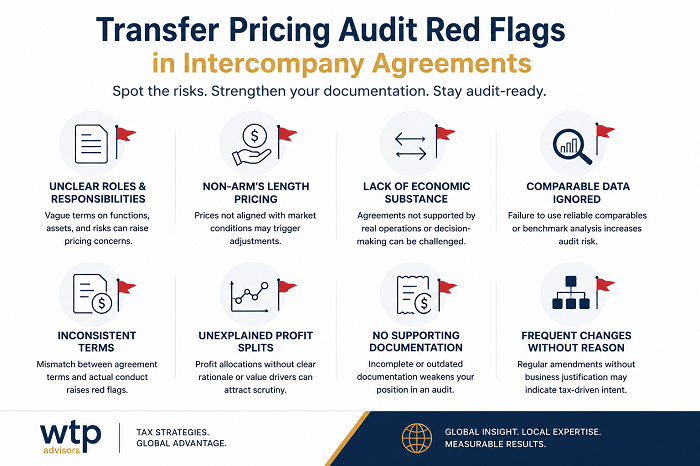
main-image

A weak agreement does not just create a documentation problem. It signals that the underlying transfer pricing may be equally weak — and justifies the auditor in expanding the scope of examination.

The Five Primary Audit Red Flags

#1

Missing Intercompany Agreements

Issue: No formal written agreement exists for one or more intercompany transactions — services rendered, IP licensed, goods transferred, or intercompany loans in place.

Risk: Tax authorities treat undocumented transactions as non-arm’s-length by default. In the U.S., penalties apply under IRC §6662(e) for undocumented related-party transactions. Deductions for intercompany payments without underlying agreements are routinely disallowed.

#2

Outdated Contracts Not Updated After Business Changes

Issue: Agreements were executed at a prior date and have not been updated following material changes to the business model, entity structure, geographic footprint, or service scope.

Risk: An agreement describing a business reality that no longer exists provides no protection for the current tax year. Auditors routinely identify discrepancies between what an agreement says and what the current financial statements show — and treat the gap as evidence of non-compliance.

#3

No Economic Justification for Pricing Terms

Issue: The price stated in the intercompany agreement (fee rate, royalty rate, markup percentage) is not supported by a contemporaneous benchmarking study or comparable uncontrolled price analysis.

Risk: Without economic support, pricing is presumed non-arm’s-length. The IRS and OECD member authorities can substitute their own pricing determination, reallocating income across jurisdictions and assessing back taxes with interest and penalties.

#4

Inconsistent Execution — Contract vs. Actual Conduct

Issue: The terms of the intercompany agreement do not match actual operational behavior: different prices are charged than stated, services described are not performed, or risk assumed under the contract is not borne in practice.

Risk: Under OECD Guidelines Chapter I, agreements that contradict actual conduct are disregarded. The tax authority reconstructs the transaction based on observed behavior — often resulting in a less favorable outcome than the contract would have provided.

#5

Vague or Unenforceable Risk Allocation

Issue: The agreement fails to clearly assign financial risk, operational responsibility, and market exposure between parties — or assigns risk to an entity that lacks the financial capacity or managerial presence to actually bear it.

Risk: Risk allocation without corresponding substance (people, capital, decision-making authority) is one of the highest-risk positions in modern transfer pricing. Post-BEPS Action 8-10, tax authorities specifically examine whether risk allocation in contracts reflects genuine economic decision-making.

How Auditors Score Red Flags

Red Flag Standalone Risk Combined Risk
Missing agreements High Audit selection near-certain
Outdated contracts Medium-High Amplifies all other red flags
No economic justification High Penalty exposure (IRC §6662)
Inconsistent execution High Recharacterization standard met
Vague risk allocation Medium-High Post-BEPS scrutiny trigger

Frequently Asked Questions

The five most common red flags are: (1) missing written agreements for intercompany transactions; (2) agreements that have not been updated after material business changes; (3) pricing terms not supported by benchmarking or economic analysis; (4) inconsistency between what the agreement says and how the business actually operates; and (5) vague or substance-free risk allocation. Any single red flag increases audit risk; multiple flags together make detailed examination nearly certain.

The IRS treats undocumented intercompany transactions as presumptively non-arm’s-length. Under IRC §482, the IRS may reallocate income between related parties to reflect arm’s-length pricing. Under IRC §6662(e), penalties of 20% (or 40% for gross valuation misstatements) apply when transfer pricing adjustments exceed threshold amounts and no contemporaneous documentation existed at the time of filing.

Agreements should be reviewed at minimum annually and updated immediately following any material change in: the nature of the transaction, the parties’ functional profiles (functions, risks, or assets), the transfer pricing methodology in use, or the jurisdictions in which the group operates. An agreement that accurately described the business three years ago but has not been updated after a restructuring provides no protection for the current year.

Inconsistent execution means the actual conduct of the parties — how they behave, what prices they charge, who bears losses, and how decisions are made — differs from what the intercompany agreement states. Under OECD Transfer Pricing Guidelines, actual conduct is the primary evidence of the real arrangement between related parties. When conduct contradicts the written agreement, the agreement is disregarded and the transaction is reconstructed based on observed behavior.

Strategic Insight — WTP ADVISORS

Audit risk increases when documentation does not evolve with business operations. Intercompany agreements are living documents — they must be maintained, updated, and kept consistent with both the economic reality of the business and the benchmarking data that prices the transactions. A single audit cycle with weak agreements can result in multi-year adjustments, penalties, and ongoing compliance scrutiny.