SUMMARY
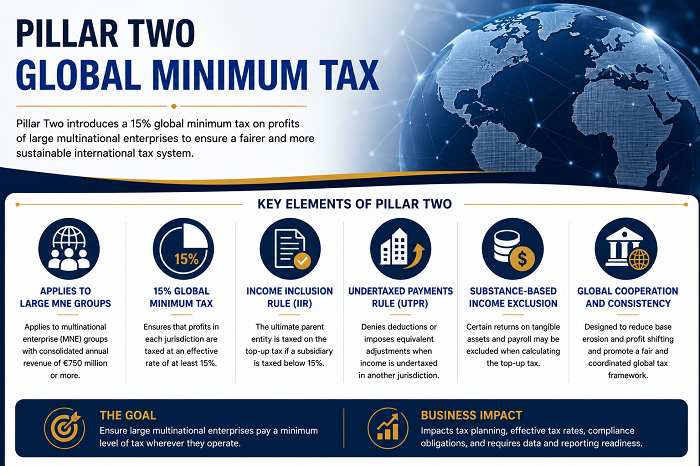
Pillar Two establishes a global minimum effective tax rate of 15% for large multinational groups (€750M+ revenue). Where a group pays less than 15% in any jurisdiction, a top-up tax is imposed. It applies on top of existing tax systems — not instead of them. U.S. multinationals are directly affected through the UTPR mechanism. GILTI alone does not satisfy Pillar Two. Compliance requires advance data readiness, entity structure review, and coordinated transfer pricing planning.
What Is Pillar Two (Global Minimum Tax)?
OECD Pillar Two / Global Anti-Base Erosion (GloBE) Rules
An international tax framework developed by the OECD/G20 Inclusive Framework that establishes a global minimum effective tax rate of 15% for large multinational enterprise (MNE) groups. Where a group’s effective tax rate in a jurisdiction falls below 15%, a top-up tax is imposed to bring it to the minimum floor. Pillar Two does not replace domestic tax systems — it operates as an additional overlay.
Pillar Two was created to address three longstanding problems in global taxation: base erosion and profit shifting (BEPS) to low-tax jurisdictions, race-to-the-bottom tax competition among countries, and the structural ability of large multinationals to pay near-zero effective rates through complex entity arrangements.
KEY POINT
Pillar Two does not tax total revenue or gross profit — it evaluates the effective tax rate on income jurisdiction by jurisdiction. A company paying 25% in one country but 5% in another is not compliant; the 5% jurisdiction triggers top-up tax.
Who Does Pillar Two Apply To?
Pillar Two applies to multinational enterprise (MNE) groups that meet all of the following:
- Consolidated annual global revenue of €750 million or more in at least two of the four preceding fiscal years
- Operations or entities in more than one jurisdiction
- Any corporate form — publicly listed, private, family-owned, or PE-backed
WARNING
U.S. companies are not exempt. Even though the United States has not enacted domestic Pillar Two legislation, U.S.-headquartered multinationals face top-up tax imposed by foreign jurisdictions through the UTPR mechanism if their effective rate falls below 15% in those countries. GILTI alone does not fully satisfy Pillar Two.
Companies below the €750M threshold may still be indirectly affected:
- Through group structures where a parent entity exceeds the threshold
- Via supply chain pricing adjustments as larger partners restructure
- Through market-level tax cost changes in jurisdictions adopting QDMTTs
How Pillar Two Works: The Three Core Rules
Pillar Two operates through three interlocking mechanisms that ensure top-up tax is collected somewhere in the group, regardless of where the parent is headquartered:
IIR — Income Inclusion Rule
Primary Rule |
Requires the parent company’s home jurisdiction to impose top-up tax when a subsidiary’s effective tax rate is below 15%. This is the primary mechanism and operates top-down through the ownership chain. |
UTPR — Undertaxed Profits Rule
Backstop Rule |
Allows other jurisdictions where the group operates to collect top-up tax if the parent’s home country has not imposed it under the IIR. Critical for U.S. multinationals whose home country has not enacted Pillar Two. |
QDMTT — Qualified Domestic Minimum Top-Up Tax
Domestic Collection |
Allows individual countries to collect top-up tax domestically before other jurisdictions act under IIR or UTPR. Keeps revenue in the source country. Now enacted in most major OECD jurisdictions. |
HOW THEY INTERACT
QDMTT is applied first (domestic collection). If no QDMTT exists or it falls short, IIR applies at the parent level. If the parent’s jurisdiction hasn’t enacted IIR, UTPR allows other group jurisdictions to collect. The system ensures top-up tax is collected regardless of legislative gaps at the parent level.
Pillar Two vs. GILTI: Critical Comparison
For U.S.-based multinational companies, the interaction between Pillar Two and GILTI is one of the most consequential — and most misunderstood — planning issues in international tax today.
| GILTI (U.S. Domestic Rule) |
Pillar Two (OECD Framework) |
| • Introduced by TCJA (2017) |
• Introduced by OECD GloBE Rules (2021) |
| • U.S. anti-deferral regime |
• Global minimum tax framework |
| • Applies to CFCs of U.S. shareholders |
• Applies to MNE groups (€750M+) |
| • Calculates at aggregate CFC level |
• Calculated jurisdiction by jurisdiction |
| • §250 deduction for C-corps (50%) |
• No equivalent §250 deduction |
| • Separate FTC basket with haircut |
• GloBE ETR calculation with SBIE |
| • High-tax exception (HTE) available |
• Transitional safe harbors available |
| • Does NOT fully satisfy Pillar Two |
• Operates on top of GILTI — not a substitute |
| Feature |
GILTI |
Pillar Two |
| Minimum effective rate |
~10.5% (C-corps after §250) |
15% (hard floor) |
| Calculation unit |
Aggregate CFC level |
Jurisdiction by jurisdiction |
| U.S. legislation enacted? |
YES |
NO (foreign IIR/UTPR applies) |
| Satisfies Pillar Two? |
PARTIAL |
N/A |
| Applies to S-corps? |
YES (no §250) |
Depends on group structure |
| Transfer pricing interaction |
YES — direct |
YES — direct |
| Safe harbors available? |
HTE election |
Transitional CbCR safe harbor |
OVERLAP RISK
U.S. multinationals paying GILTI may still owe Pillar Two top-up tax in foreign jurisdictions — creating double-layer compliance and potential double taxation without careful coordinated international tax planning.
Industries Most Exposed to Pillar Two
| Industry |
Primary Exposure Factors |
| Technology & SaaS |
IP held in low-tax jurisdictions; licensing models concentrate income offshore; high margins make ETR gaps visible |
| Manufacturing |
Fragmented cross-border supply chains; production entities in low-tax zones; TP for goods is high-scrutiny |
| Private Equity Portfolios |
Rapid cross-border scaling; layered entity structures; hold co. jurisdictions may trigger UTPR |
| Pharma & Life Sciences |
IP ownership in low-tax hubs; royalty-heavy intercompany models; R&D structures under scrutiny |
| Financial Services |
Complex entity structures; intercompany financing arrangements; cross-border fund structures |
Common Misconceptions About Pillar Two
MYTH
“Pillar Two only affects European companies.”
False. U.S. multinationals meeting the €750M threshold are directly affected. Foreign jurisdictions can impose top-up tax on U.S. group members through the UTPR even without U.S. domestic Pillar Two legislation.
MYTH
“Pillar Two replaces existing tax systems.”
False. Pillar Two is an additional layer — a minimum floor — imposed on top of existing domestic tax systems and treaty networks. All existing taxes, GILTI, transfer pricing rules, and tax treaties still apply.
MYTH
“We’re under €750M so Pillar Two doesn’t affect us.”
Not necessarily. Subsidiaries of larger groups may be in-scope at the group level even if the individual subsidiary is small. Indirect effects through supply chain repricing and holding company structures can also apply.
MYTH
“Our GILTI payment satisfies Pillar Two.”
Not reliably. GILTI is calculated at the aggregate CFC level while Pillar Two requires a jurisdiction-by-jurisdiction ETR assessment. A blended GILTI rate may satisfy the 15% average while individual jurisdictions fall below the floor. Review the OECD Pillar Two framework alongside current U.S. international tax rules before assuming compliance.
Pillar Two and Transfer Pricing: The Direct Connection
Pillar Two does not replace transfer pricing rules — it operates on top of them. The interaction is direct and consequential:
- Transfer pricing determines local taxable income in each jurisdiction
- Pillar Two evaluates the effective tax rate on that locally-determined income
- Misaligned or non-arm’s-length pricing distorts ETR calculations at the jurisdiction level
- Intercompany royalty arrangements that shift income to low-tax jurisdictions may trigger both transfer pricing scrutiny and Pillar Two top-up tax simultaneously
PLANNING NOTE
Transfer pricing and Pillar Two planning must be coordinated — not run as separate workstreams. A transfer pricing restructuring that increases income in a low-tax jurisdiction may reduce TP risk while increasing Pillar Two top-up tax exposure. Both must be modeled together.
The Data Problem: Why Compliance Fails Before It Starts
For most multinational companies, the binding constraint on Pillar Two compliance is not tax law knowledge — it is data availability. Pillar Two requires jurisdiction-level effective tax rate calculations, which demands financial data that most global reporting systems were not designed to produce.
Common data gaps that create Pillar Two compliance risk:
- No standardized jurisdiction-level ETR tracking in existing ERP or financial reporting systems
- Entity-level income and tax data not available in a consistent format across jurisdictions
- Deferred tax asset/liability positions not calculated per jurisdiction under GloBE rules
- Transfer pricing adjustments not reflected in entity-level financial statements in real time
- No single consolidated data source for the group-wide GloBE calculation
OPERATIONAL RISK
Companies that wait until a Pillar Two filing deadline to discover their data infrastructure is inadequate face reactive compliance at significant cost. The data readiness assessment must happen now — not at year-end.
What Companies Should Do Now: Six-Step Action Plan
| 1 |
Map the global entity structure
Document every entity in the group, the jurisdiction in which it is tax resident, and where economic activity and profits are generated. Identify whether the group meets the €750M threshold at the consolidated level.
|
| 2 |
Identify low-tax jurisdiction exposure points
Calculate the current effective tax rate for each jurisdiction using available financial data. Flag any jurisdiction where the ETR falls below 15% as a potential top-up tax exposure point. Apply transitional safe harbor rules where available to simplify the initial analysis.
|
| 3 |
Review transfer pricing for Pillar Two alignment
Ensure intercompany pricing reflects arm’s-length standards and does not artificially shift income to low-tax jurisdictions in a way that creates ETR gaps. Coordinate transfer pricing review with the Pillar Two ETR modeling — they are not independent.
|
| 4 |
Model effective tax rate impact across jurisdictions
Run GloBE ETR simulations across all relevant jurisdictions, applying substance-based income exclusions (SBIE) for payroll and tangible assets, and quantify the top-up tax exposure that remains after exclusions and safe harbors.
|
| 5 |
Assess and upgrade reporting system readiness
Determine whether existing financial systems can produce the jurisdiction-level data required for GloBE reporting. Most companies require system upgrades or new data collection processes — this work cannot be deferred until filing season.
|
| 6 |
Evaluate structural options before enforcement increases
Where top-up tax exposure is identified, assess whether entity restructuring, increased substance in key jurisdictions, pricing adjustments, or financing structure changes can reduce the gap. Structural options narrow significantly once enforcement activity increases in key jurisdictions.
|