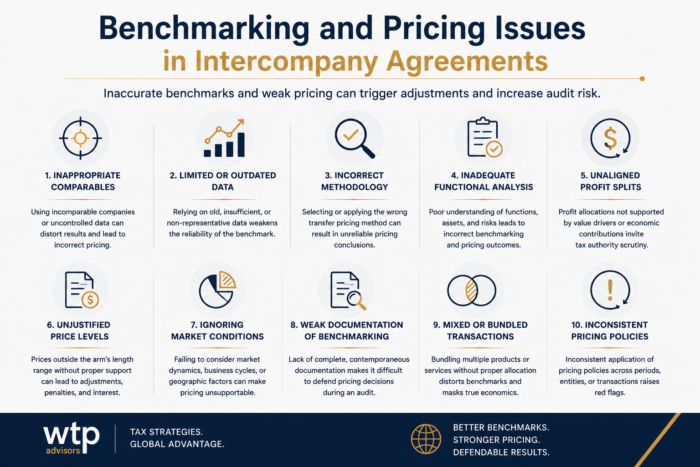
The Benchmark vs. Contract Disconnect Problem
The most prevalent benchmarking failure in intercompany agreements is a structural disconnect: companies create or execute agreements at one point in time, perform benchmarking at a different point, and never reconcile the two. This creates a pricing gap between what the agreement states and what the benchmarking data supports.
| How It Should Work |
How It Often Works (Risk Pattern) |
- Benchmarking study performed first
- Arm’s-length range established
- Agreement price set within that range
- Annual review confirms ongoing compliance
- Benchmarking updated every 3 years (or on change)
|
- Agreement drafted based on internal estimates
- Benchmarking performed later (or not at all)
- No reconciliation between study results and contract rate
- Rate drifts outside arm’s-length range over time
- Audit triggered by pricing inconsistency
|
Pricing Inconsistency Scenarios and Tax Risk
| Scenario |
Contract Rate |
Benchmark Range |
Risk Level |
| Intercompany service fee |
2% |
5–8% |
High — undercharging parent |
| IP royalty rate |
4% |
1–3% |
High — overpricing to low-tax jurisdiction |
| Intercompany loan interest |
8% |
3–5% |
High — inflated deduction |
| Distribution markup |
6% |
8–12% |
High — profit shifted from distributor |
| Cost sharing contribution |
Flat fee |
Varies by R&D spend |
Medium — methodology mismatch |
TAX RISK NOTE
Each scenario above — where the contract rate falls outside the benchmarked arm’s-length range — constitutes a transfer pricing position that tax authorities can challenge. The IRS may adjust income to the midpoint of the arm’s-length range and assess back taxes, interest, and penalties under IRC §6662(e).
Specific Pricing Inconsistency Risks
Undercharging Intercompany Services
When a parent company provides services to a subsidiary but charges below the arm’s-length range, the parent’s taxable income is understated. Tax authorities in the parent’s jurisdiction may assess additional income at the arm’s-length rate, increasing the parent’s tax liability and potentially triggering penalties.
Overpricing IP Royalties to Low-Tax Jurisdictions
When royalties charged to a high-tax subsidiary for IP owned by a low-tax entity exceed the arm’s-length rate, the arrangement artificially shifts income to the low-tax jurisdiction. This is one of the most scrutinized areas under post-BEPS Pillar Two and Action 8 (Hard-to-Value Intangibles).
Inconsistent Margins Across Jurisdictions
When the same type of transaction generates materially different margins in different jurisdictions without economic justification, tax authorities infer that pricing is not arm’s-length and may apply a global uniform margin adjustment across all jurisdictions. Additional guidance on arm’s-length pricing standards is outlined in the OECD Transfer Pricing Guidelines.