Frequently Asked Questions
There are four core documentation components required for transfer pricing compliance: (1) a written intercompany agreement that defines the transaction, pricing, and responsibilities; (2) a functional analysis mapping which entity performs functions, bears risks, and owns assets; (3) a contemporaneous benchmarking study supporting the pricing methodology and rate; and (4) financial data supporting actual execution — invoices, payment records, and cost allocations. All four components must exist at the time of filing to qualify for penalty protection.
Contemporaneous documentation means transfer pricing records were prepared before or at the time of tax filing — not after an audit begins. In the United States under IRC §6662, a taxpayer can avoid transfer pricing penalties by demonstrating that contemporaneous documentation existed at the time of filing and that the taxpayer reasonably relied on it. Documentation prepared after receipt of an audit notice is generally not accepted as contemporaneous and provides no penalty relief.
Under IRC §6662(e), a 20% accuracy-related penalty applies when a transfer pricing adjustment exceeds the lesser of $5 million or 10% of gross receipts. The penalty increases to 40% under IRC §6662(h) for gross valuation misstatements (when the price claimed is 200% or more — or 50% or less — of the correct arm’s-length amount). The penalty is waived if the taxpayer had contemporaneous documentation at the time of filing and the documentation was adequate for the positions taken.
Both — but actual operations control when there is a conflict. A functional analysis must document what each entity actually does: the decisions it makes, the people it employs, the risks it genuinely bears, and the assets it uses. Where the functional analysis reveals that actual operations differ from what the intercompany agreement states, the agreement may need to be revised. A functional analysis that simply restates the contract without independent verification of actual operations provides weak audit protection.
How WTP Advisors Supports Documentation Strategy
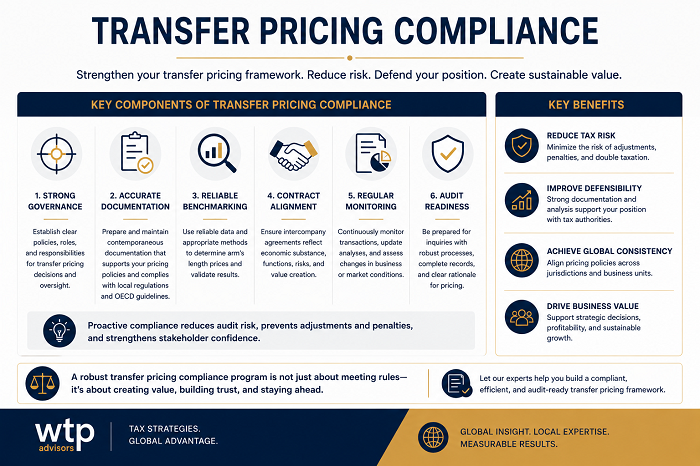
WTP Advisors assists multinational companies in building audit-ready intercompany agreement documentation packages that satisfy contemporaneity requirements, align with current OECD standards, and integrate with the company’s broader transfer pricing policy. Our documentation services include:
- Intercompany agreement drafting and review aligned with TP methodology
- Functional analysis preparation reflecting actual business operations
- Benchmarking studies using recognized databases and accepted methods
- Contemporaneous documentation packages coordinated with tax filing timelines
- Transfer pricing penalty exposure assessment and risk reduction planning
WTP ADVISORS
Documentation is not support material. It is legal defense infrastructure. The distinction matters because companies that treat documentation as a formality — something to be assembled after the fact — consistently face the highest exposure in transfer pricing audits. Documentation built as a proactive compliance system, integrated with the business before filing, is the standard that withstands scrutiny.
Strategic Insight — KEY PRINCIPLE
The difference between a defensible transfer pricing position and a penalized one is almost always a documentation gap — not an economic error. Pricing can be correct. Intent can be legitimate. But without contemporaneous documentation that proves both at the time of filing, the position is indefensible under audit. Build documentation as you structure — not after you file.