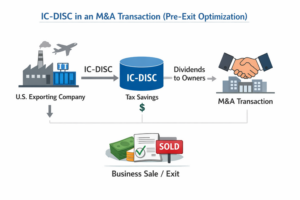
1. Why Buyers Scrutinize IC-DISC Structures
Buyers — particularly private equity firms and strategic acquirers — evaluate:- Sustainability of tax savings
- Compliance with qualification rules
- Documentation integrity
- Interaction with transfer pricing
- Exposure to IRS adjustment
- Discount projected cash flows
- Adjust purchase price
- Require indemnification
- Increase escrow reserves
2. EBITDA vs. Cash Flow: Understanding the Impact
IC-DISC commissions are deductible to the operating company and paid to the IC-DISC entity. Depending on ownership structure:- EBITDA may decrease due to commission expense
- Shareholder-level cash flow may increase through dividend arbitrage
- Whether commission structure affects EBITDA presentation
- Whether adjustments can be made without creating audit risk
- Whether the buyer will maintain the IC-DISC post-closing
3. Redetermination Before Sale
Many companies fail to perform annual IC-DISC redeterminations. Before entering a transaction process, companies should:- Recalculate commissions using both 4% and 50% methods
- Evaluate marginal costing approaches
- Confirm export property qualification
- Review gross receipts calculations
4. Qualification and Documentation Review
IC-DISC qualification errors discovered during diligence can significantly disrupt a deal. Pre-sale review should confirm:- 95% qualified export receipts test
- 95% qualified export assets test
- Proper shareholder elections
- Timely filings
- Accurate commission calculations
- Commission computation workpapers
- Export transaction support
- Intercompany agreements
- Dividend records
5. Coordination with Transfer Pricing
For multinational exporters, IC-DISC modeling must align with transfer pricing policies. If foreign distributors are earning above-market returns under a benchmarking study, U.S. profitability — and thus IC-DISC commissions — may be understated. Buyers will assess:- Whether transfer pricing and IC-DISC modeling are consistent
- Whether adjustments are defensible
- Whether audit risk exists on either side
6. Stock Sale vs. Asset Sale Considerations
Transaction structure affects IC-DISC treatment.Stock Sale
The IC-DISC entity may transfer with the operating company. Buyers must evaluate whether to maintain or unwind the structure.Asset Sale
The IC-DISC may remain with the seller. Planning must consider:- Commission timing
- Dividend distributions
- Wind-down strategy
- Retained earnings exposure
7. Retained Earnings and Dividend Planning
IC-DISC entities often accumulate retained earnings. Pre-exit considerations include:- Whether to distribute earnings before closing
- Dividend timing relative to tax rates
- Shareholder-level tax impact
- Alignment with transaction proceeds
8. Representations, Warranties, and Indemnities
Buyers frequently require representations regarding:- Compliance with IC-DISC rules
- Absence of IRS audits
- Accuracy of commission calculations
- Purchase price reductions
- Escrow holdbacks
- Special indemnities
9. When IC-DISC Stops Making Sense Pre-Exit
In some cases, IC-DISC continuation may not be optimal before sale:- If margins decline significantly
- If export mix changes
- If ownership restructuring creates complexity
- If compliance weaknesses are substantial
10. Pre-Exit IC-DISC Optimization Checklist
Before launching a sale process, companies should:- Conduct commission redeterminations
- Refresh documentation
- Reconcile export qualification tests
- Align transfer pricing policies
- Model shareholder-level tax impact
- Review retained earnings strategy
- Confirm governance and recordkeeping
Key Takeaways
IC-DISC planning can influence:- After-tax cash flow
- Valuation multiples
- Deal negotiations
- Indemnity exposure
- Audit risk
Frequently Asked Questions: IC-DISC in M&A Transactions
Q1: Why do buyers scrutinize IC-DISC structures during M&A transactions?
A1: Buyers, especially private equity firms and strategic acquirers, scrutinize IC-DISC structures to assess the sustainability of tax savings, compliance with qualification rules, documentation integrity, interaction with transfer pricing, and exposure to IRS adjustments. Flawed IC-DISC structures can lead to discounted projected cash flows, adjusted purchase prices, indemnification requirements, or increased escrow reserves, making well-structured IC-DISC planning crucial for reducing diligence friction.
Q2: How does IC-DISC impact EBITDA and cash flow in the context of an M&A transaction?
A2: IC-DISC commissions are deductible to the operating company and paid to the IC-DISC entity. This can decrease EBITDA due to the commission expense, while shareholder-level cash flow may increase through dividend arbitrage. Since buyers typically value EBITDA and sellers focus on after-tax cash flow, pre-exit modeling must evaluate how the commission structure affects EBITDA presentation, whether adjustments can be made without creating audit risk, and if the buyer will maintain the IC-DISC post-closing.
Q3: What is the importance of IC-DISC redetermination and documentation review before a sale?
A3: Many companies fail to perform annual IC-DISC redeterminations. Before a transaction, companies should recalculate commissions using both 4% and 50% methods, evaluate marginal costing approaches, confirm export property qualification, and review gross receipts calculations. Optimized redeterminations can increase accumulated tax savings. Additionally, a pre-sale review of qualification (95% qualified export receipts/assets tests, proper shareholder elections, timely filings) and documentation (commission workpapers, export transaction support, intercompany agreements, dividend records) is essential to prevent deal disruptions and reduce indemnity exposure.
Q4: Why is coordination between IC-DISC modeling and transfer pricing crucial in M&A scenarios?
A4: For multinational exporters, IC-DISC modeling must align with transfer pricing policies. If foreign distributors are earning above-market returns, U.S. profitability and thus IC-DISC commissions may be understated. Buyers will assess the consistency of transfer pricing and IC-DISC modeling, the defensibility of adjustments, and potential audit risks. Fragmented planning in these areas reduces credibility and can negatively impact deal negotiations.
Q5: What are the key considerations for retained earnings and dividend planning for an IC-DISC entity prior to an M&A exit?
A5: IC-DISC entities often accumulate retained earnings, necessitating careful pre-exit planning. Considerations include whether to distribute earnings before closing, the timing of dividends relative to tax rates, the shareholder-level tax impact, and alignment with transaction proceeds. Improper timing of these distributions can significantly reduce the realized tax benefit for the sellers.