What Is FDII and How Does It Reduce Tax?
FDII (Foreign-Derived Intangible Income) is a deduction available exclusively to domestic C-corporations under IRC Section 250. It reduces taxable income on qualifying foreign-derived revenue — including goods sold to foreign customers, services rendered to foreign persons, and income from licensing intangible property abroad. The FDII deduction produces an effective federal tax rate of approximately 13.1% on qualifying income, compared to the standard 21% C-corporation rate.
FDII can be especially relevant for companies involved in international tax planning and businesses evaluating export-related tax strategies alongside international tax considerations.
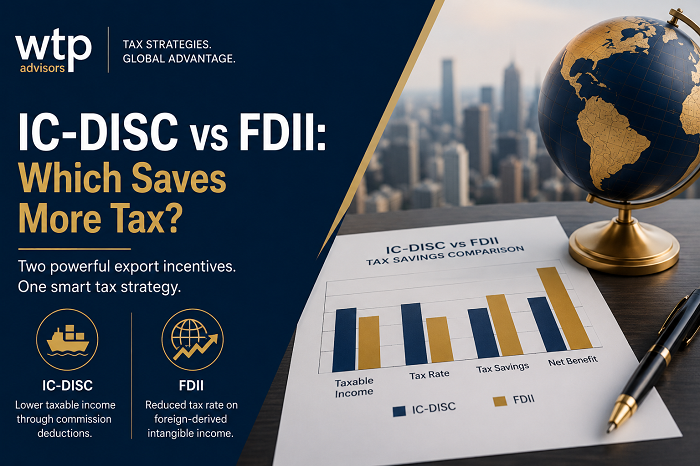
IC-DISC vs FDII: Direct Comparison Table
| Factor |
IC-DISC |
FDII |
| Available to S-corps and partnerships? |
Yes |
No |
| Available to C-corporations? |
Yes |
Yes |
| Mechanism |
Commission shift to related entity |
Direct deduction on corporate return |
| Effective rate on qualifying income |
23.8% individual dividend rate |
Approximately 13.1% |
| Requires separate entity? |
Yes |
No |
| Best income type |
Physical goods exports |
Services, digital income, and licensed IP |
| Annual compliance cost |
$5,000–$20,000 |
Minimal, generally Form 8993 only |
When IC-DISC Produces Higher Savings Than FDII
IC-DISC may produce larger tax savings than FDII when the operating entity is an S-corporation or partnership, because FDII is not available to those entity types. It can also be beneficial when individual shareholders are in the 37% ordinary income bracket and qualify for the 23.8% qualified dividend rate.
IC-DISC is often strongest for companies exporting tangible goods manufactured or produced in the United States, especially when combined taxable income margins on export activity exceed 20%. Companies evaluating this strategy should also review WTP Advisors’ IC-DISC services and What Is an IC-DISC? resource.
When FDII Produces Higher Savings Than IC-DISC
FDII may outperform IC-DISC for C-corporations when export revenue comes primarily from software, SaaS subscriptions, consulting services, or licensed intangible property. It may also be preferable when the corporate shareholder structure does not benefit from qualified dividend rates or when forming a separate IC-DISC entity is impractical.
FDII can be especially relevant for companies focused on international tax planning and broader international tax strategies.
When Should a Company Model Both IC-DISC and FDII?
Any C-corporation with more than $2 million in qualifying export revenue should model both IC-DISC and FDII before committing to either strategy. Companies with mixed revenue, including physical goods and services, may be able to apply IC-DISC to one revenue segment and FDII to another.
Modeling should use actual revenue figures, current profit margins, and applicable shareholder tax rates instead of rough estimates. For official filing guidance, companies can review the IRS information for Form 1120-IC-DISC and Form 8993.
Timing Note
For IC-DISC, the entity must be formed and the election filed within 90 days of the start of the tax year. A calendar-year company must generally have IC-DISC in place by approximately March 31 of the benefit year. FDII requires no pre-year election.
Related Pages — IC-DISC vs FDII Cluster
Should I Switch From FDII to IC-DISC?
Switching from FDII to IC-DISC may make sense for C-corporations whose export revenue has shifted toward physical goods, whose shareholders benefit from the qualified dividend rate differential, or whose FDII benefit is constrained by deduction phase-downs or mixed-entity complications.
What Triggers a Company to Consider Switching from FDII to IC-DISC?
The most common triggers include rising qualified export receipts from physical goods, a shift in shareholder composition toward individual owners who benefit from qualified dividend rates, a reduction in the FDII deduction rate, and acquisition or restructuring events that change entity type or revenue classification.
What Does Switching from FDII to IC-DISC Actually Require?
Switching is not a simple tax election change. It requires forming a new domestic corporation, filing a timely IC-DISC election, executing a commission agreement between the exporter and the IC-DISC, completing annual qualification testing, and filing a separate annual tax return on Form 1120-IC-DISC.
When Switching to IC-DISC Is the Right Decision
Switching to IC-DISC may be favorable when the company is restructuring from a C-corporation to an S-corporation or partnership, exports consist primarily of manufactured goods, shareholders benefit from qualified dividend treatment, or the FDII deduction rate has been reduced enough that IC-DISC produces a larger net benefit after compliance costs.
When Switching from FDII to IC-DISC Is Not Advisable
Switching may not be advisable when the C-corporation has institutional investors or foreign shareholders who do not benefit from qualified dividend treatment, ownership covenants restrict subsidiary formation, IC-DISC compliance costs exceed incremental savings, or export revenue consists mainly of services, SaaS subscriptions, or licensed intangibles better suited to FDII.
What Are the Risks of Switching Incorrectly?
Risks include IRS scrutiny of IC-DISC elections filed shortly after restructuring, loss of FDII deductions in the transition year, commission agreements that do not predate qualifying transactions, and failure of annual qualification tests that may disqualify the IC-DISC for the affected year.
How Should the Switch Decision Be Made?
The decision should be made by modeling both strategies over a 3-to-5-year horizon using actual revenue projections, shareholder tax rates, and estimated compliance costs. A single-year comparison is rarely sufficient because IC-DISC setup costs are front-loaded and compliance costs are recurring.
FDII Rate Risk
The FDII deduction is scheduled to decrease from 37.5% to 21.875% after 2025 under TCJA sunset provisions. This reduction increases the effective federal rate on qualifying FDII income from approximately 13.1% to approximately 16.4%. Any switch analysis should model both current and reduced-rate scenarios.