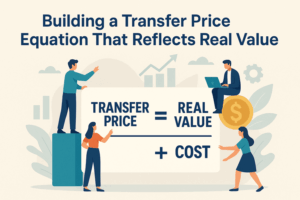
From Numbers to Narrative
A well-designed
transfer price equation is more than arithmetic — it’s a narrative that expresses how your organization creates and shares value. In modern transfer pricing, equations serve as the bridge between financial models and business reality. They translate functional analyses, risk assessments, and benchmarking results into quantifiable pricing logic that tax authorities can verify and management can trust.
At
WTP Advisors, we help clients build and implement dynamic transfer price equations that balance simplicity, flexibility, and defensibility.
Why a Formulaic Approach Matters
As outlined in
What Is Transfer Pricing?, the arm’s-length principle requires that related entities transact as independent parties would. Yet this principle becomes complex in integrated global operations, where functions overlap and value creation is distributed. A
transfer price equation helps cut through that complexity by formalizing how profit is distributed based on objective drivers, not assumptions.
A well-structured equation ensures transparency and repeatability. It allows your pricing policy to remain stable even as the business scales or restructures, because the underlying logic — not arbitrary percentages — drives the results.
The Anatomy of a Transfer Price Equation
At its core, an equation can look simple:
Transfer Price = (Base Cost × α) + (Risk Premium × β) + (Intangible Return × γ)
Here, α, β, and γ represent coefficients tied to measurable business factors. They can be derived from empirical data, functional intensity, or benchmarking results. This structure accommodates the varying economic roles within your group — for instance, manufacturing entities may have higher α values (cost-driven), while R&D centers carry greater γ values (intangible-driven).
By quantifying these relationships, the equation becomes a transparent map of how value flows through the organization. It turns subjective decision-making into structured governance.
Building the Equation Step by Step
WTP Advisors’ process for designing a robust transfer price equation typically involves:
- Identifying Core Drivers: Determine what actually drives profitability — costs, volume, innovation, or customer base.
- Calibrating Weights: Assign coefficients based on real-world evidence from benchmarking studies or internal performance data.
- Testing for Alignment: Run simulations to ensure the output mirrors both economic substance and arm’s-length ranges.
- Operational Embedding: Integrate the model into ERP systems so it automatically updates as data changes.
This iterative process ensures that the equation reflects true business activity and can evolve with changing market conditions.
Integrating Into Real-Time Systems
Embedding the
transfer price equation within your ERP or consolidation software creates a living model rather than a static report. When exchange rates shift or production costs fluctuate, the equation recalculates instantly. That continuous responsiveness not only keeps intercompany prices compliant but also provides management with up-to-date margin visibility.
A global technology client showcased in our
Transfer Pricing Case Studies implemented this approach across 14 entities. The automated recalculation process reduced their year-end adjustments by 90% and strengthened their audit defense documentation.
The Broader Value of Mathematical Precision
Equations lend credibility. When regulators challenge transfer pricing positions, being able to show a structured, data-based model carries persuasive power. The logic is transparent, the data is traceable, and the outcome is reproducible.
Internally, equations also drive efficiency. Management can forecast profits more accurately, and finance teams can reconcile data across subsidiaries seamlessly. It becomes a single source of truth for intercompany pricing.
Continuous Calibration
Markets evolve, and so should your equation. WTP Advisors recommends recalibrating coefficients periodically based on updated benchmarking data or changes in functional risk. Some companies even employ rolling analyses every six months, ensuring their transfer price equation remains aligned with economic reality.
This proactive approach prevents surprises during tax audits and helps sustain stable, defendable results year over year.
Conclusion
A well-designed
transfer price equation captures not just cost and profit, but the story of how your business creates value. It transforms compliance into clarity, turning regulatory expectations into management insight. By embedding the equation into your systems and recalibrating it regularly, you create a living model that evolves with your business.
At
WTP Advisors, we specialize in crafting equations that tell your company’s value-creation story in numbers — precise, defensible, and strategically aligned.