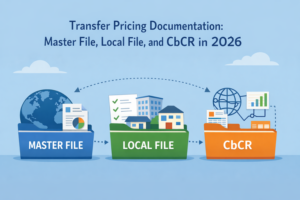
Robust transfer pricing documentation is the cornerstone of compliance for multinational enterprises (MNEs). It serves as the primary means to demonstrate that intercompany transactions are conducted at arm’s length and to mitigate the risk of transfer pricing adjustments and penalties during tax audits. In 2026, MNEs continue to navigate the three-tiered documentation structure introduced by the OECD’s Base Erosion and Profit Shifting (BEPS) Action 13: the Master File, the Local File, and the Country-by-Country Report (CbCR). Adhering to these requirements is crucial for transparency and effective risk management.
The Three-Tiered Documentation Structure
1. Master File
The Master File provides a high-level overview of the MNE group’s global business operations and transfer pricing policies. It aims to provide tax administrations with a comprehensive understanding of the MNE’s global value chain, how it generates value, and how its transfer pricing policies are applied consistently across the group.
Key contents typically include:
- Organizational Structure: A chart illustrating the MNE’s legal and ownership structure.
- Description of Business: A general description of the MNE’s business, including important drivers of profit.
- Intangibles: A description of the MNE’s overall strategy for intangibles, including location of R&D facilities, ownership of intangibles, and transfer pricing policies related to intangibles.
- Intercompany Financial Activities: A description of how the group is financed, including significant financing arrangements.
- Financial and Tax Positions: The MNE’s consolidated financial statements and a list of its Advance Pricing Agreements (APAs) and other tax rulings.
The Master File is intended to be a single document applicable to the entire MNE group, providing a global context for local tax authorities.
2. Local File
The Local File provides specific information relevant to the material intercompany transactions of the local entity in each jurisdiction. It complements the Master File by offering detailed transaction-specific information and analysis.
Key contents typically include:
- Local Entity Information: A description of the management structure, business strategy, and key competitors of the local entity.
- Material Controlled Transactions: A detailed description of each material intercompany transaction, including the nature of the transaction, the amounts involved, and the parties involved.
- Functional Analysis: A detailed functional analysis of the local entity and the associated enterprises involved in the controlled transactions, identifying functions performed, assets used, and risks assumed.
- Comparability Analysis: Information on the selection of the most appropriate transfer pricing method and the application of that method, including a comparability analysis and the identification of comparable uncontrolled transactions or companies.
- Financial Information: Financial data used in the application of the transfer pricing method, and a reconciliation of financial data to statutory accounts.
The Local File is jurisdiction-specific and must be prepared for each relevant entity within the MNE group.
3. Country-by-Country Report (CbCR)
The CbCR provides tax authorities with aggregate information annually, by tax jurisdiction, relating to the global allocation of the MNE group’s income, taxes paid, and certain indicators of economic activity. It also identifies all the MNE group’s constituent entities operating in a given tax jurisdiction and the main business activity of each constituent entity.
The CbCR is filed by the ultimate parent entity of an MNE group (or a surrogate parent entity) and is then exchanged between tax authorities under international agreements.
Key data points include:
- Revenue (related party and unrelated party)
- Profit (loss) before income tax
- Income tax paid (cash basis)
- Income tax accrued (current year)
- Stated capital
- Accumulated earnings
- Number of employees
- Tangible assets other than cash and cash equivalents
The CbCR is a risk assessment tool for tax authorities, helping them identify potential BEPS risks and target audit resources more effectively.
Challenges and Best Practices in 2026
- Data Collection and Management MNEs face significant challenges in collecting, consolidating, and managing the vast amounts of data required for all three tiers of documentation.
- Consistency Across Tiers Ensuring consistency between the Master File, Local Files, and CbCR is critical. Inconsistencies can raise red flags for tax authorities.
- Timeliness Documentation must be prepared and available by specific deadlines, which vary by jurisdiction.
- Local Nuances While the OECD guidelines provide a framework, local country regulations may have specific additional requirements or updates in 2026.
Best Practices:
- Centralized Coordination: Implement a centralized approach to manage global transfer pricing documentation, ensuring consistency and efficiency.
- Leverage Technology: Utilize technology solutions for data extraction, analysis, and report generation to streamline the documentation process.
- Regular Review and Update: Periodically review and update all documentation to reflect changes in business operations, market conditions, and regulatory requirements.
- Proactive Engagement: Consider engaging with tax authorities through APAs to gain certainty on complex transactions and reduce documentation burdens.
FAQs on Transfer Pricing Documentation
Q1: What is the primary purpose of the Master File in transfer pricing documentation?
A1: The primary purpose of the Master File is to provide a high-level overview of the multinational enterprise (MNE) group’s global business operations and transfer pricing policies. It gives tax administrations a comprehensive understanding of the MNE’s global value chain, how it generates value, and how its transfer pricing policies are applied consistently across the group, setting the global context for local analyses.
Q2: How does the Local File differ from the Master File?
A2: The Local File differs from the Master File by providing specific, detailed information relevant to the material intercompany transactions of the local entity in a particular jurisdiction. While the Master File offers a global perspective, the Local File focuses on the local entity’s management, business strategy, functional analysis, comparability analysis, and financial information related to its controlled transactions.
Q3: What kind of information is included in the Country-by-Country Report (CbCR)?
A3: The CbCR includes aggregate information, reported annually by tax jurisdiction, on the MNE group’s global allocation of income, taxes paid (cash and accrued), and certain indicators of economic activity such as stated capital, accumulated earnings, number of employees, and tangible assets. It also identifies all constituent entities operating in each jurisdiction and their main business activities.
Q4: Who is typically responsible for filing the Country-by-Country Report?
A4: The ultimate parent entity of an MNE group is typically responsible for filing the Country-by-Country Report (CbCR) in its jurisdiction of residence. In certain circumstances, a surrogate parent entity or even a local entity may be required to file the CbCR if the ultimate parent entity is not obligated to file or if there is no exchange agreement in place.
Q5: What are the main challenges MNEs face in complying with the three-tiered transfer pricing documentation requirements?
A5: MNEs face several challenges, including the extensive data collection and management required across all three tiers, ensuring consistency of information between the Master File, Local Files, and CbCR, meeting specific and often varying jurisdictional deadlines, and addressing local nuances in documentation requirements that go beyond the OECD guidelines. Inconsistencies or incomplete documentation can lead to increased audit scrutiny and potential penalties.