The concept of a Permanent Establishment (PE) is fundamental to international taxation, determining when a non-resident enterprise is deemed to have a taxable presence in another jurisdiction. While traditionally associated with physical fixed places of business, the definition of a PE has evolved, particularly with the rise of digitalization and remote work. In 2026, multinational enterprises (MNEs) face increasing scrutiny regarding the existence of PEs and the accurate attribution of profits to them, making transfer pricing for PEs a critical area for compliance and risk management.
Understanding Permanent Establishments and Profit Attribution
A PE typically arises when an MNE has a fixed place of business (e.g., an office, factory, branch) in a foreign country, or when a dependent agent habitually concludes contracts on its behalf. The significance of a PE for transfer pricing is that profits attributable to that PE become taxable in the host jurisdiction. The attribution of profits to a PE is governed by Article 7 of the OECD Model Tax Convention, which advocates for the Authorized OECD Approach (AOA).
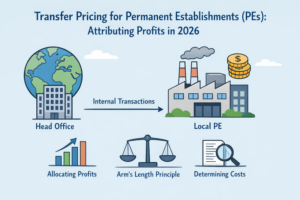
The AOA treats the PE as a separate enterprise, distinct from the rest of the MNE, performing its own functions, using its own assets, and assuming its own risks. This “fiction” allows for the application of arm’s length principles to transactions between the PE and other parts of the MNE.
Key steps in profit attribution under the AOA include:
- Delineation of the PE’s Functions, Assets, and Risks A thorough functional analysis is performed to identify the activities carried out by the PE, the assets it employs, and the risks it assumes.
- Hypothetical Capital Allocation The PE is deemed to have the capital it would require if it were a separate enterprise, considering its functions and risks.
- Arm’s Length Pricing of Internal Dealings Transactions between the PE and other parts of the MNE (e.g., provision of services, use of intangibles, internal funding) are priced at arm’s length.
Evolving PE Concepts and Transfer Pricing Challenges
- Digital PEs The digital economy has challenged traditional PE definitions. While the OECD’s BEPS project (Action 7) has expanded the definition of PE to include certain commissionaire arrangements and specific services, the concept of a “digital PE” based solely on a significant digital presence without physical presence remains a subject of ongoing debate and unilateral measures by some countries.
- Service PEs The provision of services in a country for a certain duration can create a service PE, requiring profit attribution based on the functions performed by the service personnel.
- Construction PEs Construction or installation projects lasting beyond a specified period (e.g., 6 or 12 months) typically constitute a PE, with profits attributable to the activities undertaken at the site.
- Remote Work and Home Office PEs The rise of remote work has raised concerns about employees working from home in a foreign jurisdiction inadvertently creating a PE for their employer. While generally not considered a PE if the home office is not at the disposal of the enterprise, specific facts and circumstances need careful assessment.
- Attribution of Intangibles If a PE is involved in the DEMPE (Development, Enhancement, Maintenance, Protection, Exploitation) functions of valuable intangibles, a portion of the returns from those intangibles may be attributable to the PE.
Documentation and Risk Mitigation in 2026
Robust documentation is paramount for managing PE risks and justifying profit attribution. This should include:
- PE Risk Assessment A proactive assessment of activities in foreign jurisdictions to identify potential PE risks.
- Functional Analysis of the PE A detailed functional analysis that clearly delineates the PE’s functions, assets, and risks, treating it as a separate enterprise.
- Internal Agreements Documentation of internal dealings between the PE and the rest of the MNE, priced at arm’s length.
- Capital Attribution Analysis Justification for the capital attributed to the PE.
- Local File Documentation The PE’s activities and profit attribution should be comprehensively documented in the Local File for the relevant jurisdiction.
Given the increasing focus of tax authorities on PE issues, MNEs should proactively review their global operating models, particularly in light of digital activities and remote work arrangements. Seeking Advance Pricing Agreements (APAs) or advance rulings on PE status can provide certainty and mitigate dispute risks.
FAQs on Transfer Pricing for Permanent Establishments (PEs)
Q1: What is a Permanent Establishment (PE) in the context of international taxation?
A1: A Permanent Establishment (PE) refers to a fixed place of business through which the business of an enterprise is wholly or partly carried on in another country. It can also arise if a dependent agent habitually concludes contracts on behalf of the enterprise. The existence of a PE triggers a taxable presence in that foreign jurisdiction, meaning profits attributable to the PE become taxable there.
Q2: How does the Authorized OECD Approach (AOA) apply to profit attribution for PEs?
A2: The AOA treats the PE as if it were a separate and distinct enterprise, performing its own functions, using its own assets, and assuming its own risks. This allows for the application of arm’s length principles to transactions between the PE and other parts of the MNE, ensuring that profits are attributed to the PE based on its economic contribution.
Q3: Can remote work arrangements create a Permanent Establishment (PE)?
A3: Yes, remote work arrangements can potentially create a PE, although it depends on specific facts and circumstances. If an employee habitually works from a home office in a foreign jurisdiction and that home office is considered to be “at the disposal” of the employer, it could constitute a fixed place of business PE. Similarly, if a remote employee acts as a dependent agent habitually concluding contracts, it could create an agency PE. MNEs need to carefully assess these risks.
Q4: What are “internal dealings” in the context of PE transfer pricing, and how are they treated?
A4: Internal dealings refer to transactions or interactions between the PE and other parts of the same MNE (e.g., the PE providing services to the head office, or the head office providing funding to the PE). Under the AOA, these internal dealings are treated as if they were arm’s length transactions between separate entities, and their pricing must adhere to transfer pricing principles to accurately attribute profits to the PE.
Q5: What steps can MNEs take to mitigate transfer pricing risks related to PEs?
A5: MNEs can mitigate PE-related transfer pricing risks by conducting proactive PE risk assessments of their global operations, performing detailed functional analyses for any potential PEs, ensuring robust documentation of internal dealings and capital attribution, and considering Advance Pricing Agreements (APAs) or advance rulings on PE status with tax authorities to gain certainty and prevent disputes.