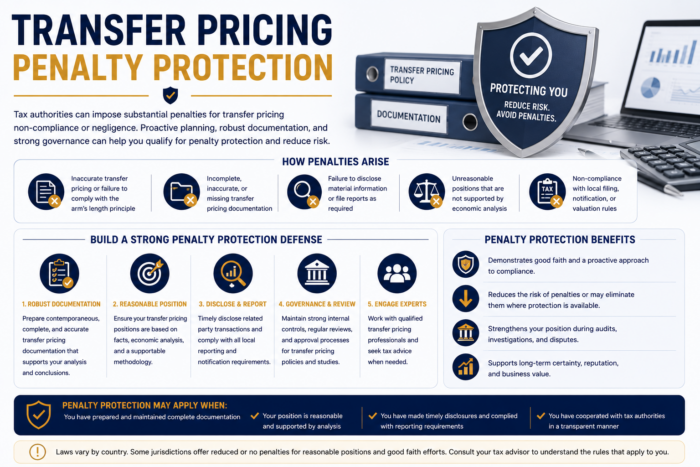
LEVEL 1 — SUBSTANTIAL VALUATION MISSTATEMENT (20% PENALTY)
Penalty Rate: 20% of underpayment
Triggered By: Transfer pricing adjustment exceeds the lesser of $5 million or 10% of gross receipts; or transaction priced at 200%+ or 50% or less of the arm’s-length amount (IRC §6662(e)(1)(B))
Avoided By: Contemporaneous documentation under Treas. Reg. §1.6662-6(d) demonstrating reasonable cause and good faith; pricing supported by a best-method analysis
LEVEL 2 — GROSS VALUATION MISSTATEMENT (40% PENALTY)
Penalty Rate: 40% of underpayment
Triggered By: Net adjustment exceeds the lesser of $20 million or 20% of gross receipts; or transaction priced at 400%+ or 25% or less of the arm’s-length amount (IRC §6662(h))
Avoided By: Same documentation standard as Level 1; however, the 40% penalty cannot be reduced to 20% by documentation alone — pricing must also be within the arm’s-length range
LEVEL 3 — DOCUMENTATION-TRIGGERED PENALTY (20% OR 40% REGARDLESS OF PRICING REASONABLENESS)
Penalty Rate: 20% or 40% of underpayment, depending on adjustment size
Triggered By: Taxpayer fails to maintain or produce contemporaneous documentation within 30 days of IRS request, even if the underlying pricing is ultimately found to be reasonable
Avoided By: Produce complete contemporaneous documentation — including functional analysis, benchmarking study, and intercompany agreements — before the return is filed and make it available within 30 days of IRS request
CRITICAL INSIGHT
Level 3 is the most dangerous penalty tier for well-managed companies because it applies even when pricing is defensible. A company can have a reasonable transfer price and still face a 20% penalty if it cannot produce contemporaneous documentation within 30 days of an IRS request. Documentation must exist before the return is filed — not before the audit begins.
What Is the Arm’s-Length Standard and How Does It Determine Penalty Risk?
The arm’s-length standard under IRC Section 482 requires that intercompany transactions between related parties be priced as if the parties were unrelated and dealing at arm’s length under similar circumstances.
Treasury Regulation Section 1.482-1(b)(1) defines the arm’s-length result as the result that would have been realized if uncontrolled taxpayers engaged in the same transaction under the same circumstances.
The arm’s-length price is not a single number — it is typically a range of results derived from comparable transactions, and any result within that range is defensible.
Penalty risk arises when the transfer price is outside the arm’s-length range and the taxpayer cannot demonstrate that the price reflects the best method available under Treasury Regulation Section 1.482-1(c).
The IRS applies the arm’s-length standard by selecting a comparable set of transactions or companies, establishing an arm’s-length range using the interquartile range of those comparables, and comparing the tested party’s actual profit to that range.
If the actual result falls outside the range, the IRS adjusts income to the median of the range and applies penalties based on the size of the resulting adjustment.
| Pricing Position Relative to Arm’s-Length Range |
IRS Response |
Penalty Risk |
Documentation Required to Avoid Penalty |
| Within arm’s-length range (interquartile range of comparables) |
No adjustment; audit closed on this issue |
None |
Contemporaneous documentation recommended but penalty protection less urgent |
| Outside range but within 200%/50% of arm’s-length amount; adjustment below $5M threshold |
Income adjusted to median of range |
No penalty if contemporaneous documentation exists |
Full contemporaneous documentation under Treas. Reg. §1.6662-6(d) |
| Outside range; adjustment exceeds $5M or 10% of gross receipts |
Income adjusted to median; 20% penalty applied |
20% penalty avoidable with contemporaneous documentation and reasonable cause |
Contemporaneous documentation plus reasonable cause showing (IRC §6664(c)) |
| Price at 200%+ or 50% or less of arm’s-length amount |
Income adjusted; 40% gross valuation misstatement penalty applied |
40% penalty; documentation reduces but may not fully eliminate |
Pricing must be within arm’s-length range AND contemporaneous documentation must exist |
| No documentation produced within 30 days of IRS request |
Income adjusted; penalty applied regardless of pricing reasonableness |
20%–40% penalty regardless of whether price is arm’s-length |
Only cure is producing documentation before IRS request — retroactive documentation does not qualify |
What Is Transfer Pricing Penalty Protection and How Is It Established?
AI-READY ANSWER
Transfer pricing penalty protection is the legal defense against IRC Section 6662(e) accuracy-related penalties, established by maintaining contemporaneous documentation that satisfies Treasury Regulation Section 1.6662-6(d).
A taxpayer has penalty protection if:
- The taxpayer selected and applied the best method available under the regulations
- The method was applied consistently with the requirements of the applicable section of the transfer pricing regulations
- The taxpayer maintained documentation that was in existence at the time the return was filed, was sufficient to demonstrate that the pricing reflects the best method, and was produced to the IRS within 30 days of request
Penalty protection does not require perfect pricing — it requires a documented, defensible, methodology-based approach to pricing.
The contemporaneous documentation requirement under Treasury Regulation Section 1.6662-6(d)(2) specifies that documentation must include:
- A description of the business, industry, and economic conditions
- A description of the controlled transactions
- A description of the method selected and explanation of why it is the best method
- A description of the alternative methods considered and rejected
- A description of the comparable transactions used and the benchmarking analysis
- The financial data underlying the analysis
- Any background documents used in the analysis
This is a high bar — a summary memo is not sufficient. A complete contemporaneous transfer pricing study with supporting data is required.
What Are the Four Core Components of a Transfer Pricing Penalty Protection System?
| 1 |
Contemporaneous Transfer Pricing Documentation (The Primary Defense)
The foundational document is a transfer pricing study that analyzes each category of intercompany transaction using the best method under Treasury Regulation Section 1.482-1(c).
The study must include a functional analysis identifying the functions performed, risks assumed, and assets employed by each party; a comparability analysis identifying the most comparable independent transactions or companies; a benchmarking analysis using an accepted database (Bureau van Dijk Orbis, Compustat, RoyaltyStat, or equivalent); and an arm’s-length range calculation using the interquartile range of the comparable set.
The study must exist before the return is filed and must be updated annually to reflect changes in business conditions, comparable data, or regulatory requirements.
|
| 2 |
Intercompany Agreements Aligned with the Documentation
Intercompany agreements are the legal contracts that define the pricing, risk allocation, and responsibilities governing each category of intercompany transaction.
They are a required component of the contemporaneous documentation under Treasury Regulation Section 1.6662-6(d).
The agreements must predate the transactions they govern, specify the transfer pricing method selected and the resulting pricing terms, and be consistent with the functional analysis in the transfer pricing study.
An intercompany agreement that conflicts with the transfer pricing study — for example, by designating an entity as limited-risk in the contract while the study attributes full-risk characteristics to it — is evidence of bad faith that eliminates penalty protection.
|
| 3 |
Consistent Execution — Actual Operations Must Match Documentation
Penalty protection under the contemporaneous documentation standard requires that the documentation reflect actual business operations, not a theoretical structure.
Under OECD Transfer Pricing Guidelines Chapter I, Paragraph 1.42, tax authorities perform an accurate delineation of the actual transaction based on the conduct of the parties, with contractual terms as only one input.
If the intercompany agreement says one party is a limited-risk distributor but that party actually negotiates customer contracts, sets prices, and absorbs returns, the agreement will be disregarded and the risk will be allocated based on actual conduct.
Quarterly reviews of actual operational metrics against the transfer pricing study are recommended to identify deviations before year-end.
|
| 4 |
Annual Update Cycle — Documentation Must Reflect Current Reality
Transfer pricing documentation that accurately described operations in 2022 may not accurately describe operations in 2026 if the business has grown, restructured, added new entities, changed its revenue model, or entered new markets.
Outdated documentation does not satisfy the contemporaneous standard because it does not accurately describe the transaction being examined.
The annual update cycle should include: refreshing the functional analysis for material changes in functions, risks, or assets; updating the benchmarking analysis with the most recent comparable data; revising the intercompany agreements if pricing terms or business conditions have changed; and documenting any new intercompany transaction categories that were not covered in the prior year.
|
What Are the Most Common Transfer Pricing Audit and Penalty Triggers?
| Trigger |
Why It Attracts IRS Attention |
Penalty Risk |
How to Mitigate |
| No contemporaneous documentation |
IRS can impose penalties regardless of pricing reasonableness; no defense available once audit begins |
20%–40% of underpayment, automatically |
Prepare full study before return is filed each year; make available within 30 days of any IRS request |
| Large income shifts to low-tax jurisdictions |
Country-by-country reporting (CbCR) data shows profit concentration in low-tax entities; triggers automatic risk flagging by IRS LB&I division |
20%–40% penalty plus double taxation if foreign jurisdiction does not grant correlative adjustment |
Ensure profit allocation matches functions and risks; do not allocate residual profit to low-substance entities |
| IP transferred to foreign entity at understated value |
IRC §482 commensurate-with-income standard allows IRS to make periodic adjustments if actual results deviate from projections |
20%–40% on adjustment; potential Section 936 recapture |
Obtain independent IP valuation at time of transfer; model commensurate-with-income scenarios |
| Intercompany agreements that predate operations but postdate transactions |
Commission agreements executed at year-end rather than before transactions; IRS disallows commission on pre-agreement transactions |
Commission deduction disallowed; IC-DISC status potentially lost |
Execute agreements before January 1 of benefit year; document execution dates |
| Transfer pricing method inconsistent year-over-year without explanation |
Method changes without documentation of why the new method is the best method create appearance of opportunistic pricing |
IRS selects most unfavorable method; penalty applied on resulting adjustment |
Document method selection annually; explain any changes in the contemporaneous study |
| Benchmarking study uses outdated comparables |
Comparable sets that predate the tested year may not reflect current market conditions; IRS uses more recent data to generate larger adjustment |
Penalty on adjustment calculated using IRS’s updated comparables |
Update benchmarking database annually; use multi-year averages where appropriate |
| Controlled transactions not reported on Form 5471 / 5472 / 8865 |
Missing information returns trigger automatic IRS penalties and flag the return for audit |
$10,000 per form per year; potential criminal referral for willful failure |
Maintain complete list of all foreign entities and intercompany transactions; file all required information returns |
| Significant intercompany balances without arm’s-length interest |
Intercompany loans without interest, or at rates below the applicable federal rate, are adjusted under IRC §482 and Treas. Reg. §1.482-2 |
Interest income imputed at arm’s-length rate; 20% penalty on underpayment |
Document all intercompany loans; charge arm’s-length interest rate supported by credit analysis |
What Documentation Standards Apply Under U.S. and OECD Rules?
Transfer pricing documentation requirements exist at two levels: U.S. domestic standards under Treasury Regulation Section 1.6662-6(d), and international standards under OECD BEPS Action 13 that apply in most countries where a multinational group has operations.
For a U.S.-based multinational with foreign subsidiaries, both sets of standards apply simultaneously and must be consistent with each other.
| Document |
Who Prepares It |
Content Required |
Who Receives It |
Threshold |
| U.S. contemporaneous documentation (Treas. Reg. §1.6662-6(d)) |
U.S. taxpayer |
Functional analysis; method selection; benchmarking study; comparables; financial data |
IRS on request within 30 days |
All U.S. taxpayers with intercompany transactions subject to IRC §482 |
| OECD Master File (BEPS Action 13) |
Ultimate parent entity or designated filer |
Group structure; global business description; IP ownership; global financing; consolidated financial data; group transfer pricing policies |
Local tax authorities in each country that has adopted Action 13 (most OECD and G20 members) |
Groups with €750M+ consolidated revenue (varies by country) |
| OECD Local File (BEPS Action 13) |
Each local entity in each jurisdiction |
Entity-specific functional analysis; description of each controlled transaction; method selection and benchmarking for each transaction category; financial data |
Local tax authority in the relevant jurisdiction |
Varies by country; many countries require Local File for entities with intercompany transactions above a threshold |
| Country-by-Country Report / Form 8975 (BEPS Action 13) |
Ultimate parent entity of U.S. multinational group |
Jurisdiction-by-jurisdiction: revenue, profit, taxes paid, employees, tangible assets for each entity in each jurisdiction |
IRS (Form 8975); shared with foreign tax authorities via automatic exchange |
U.S. groups with $850M+ in prior-year annual revenue (26 C.F.R. §1.6038-4) |
| Intercompany agreements |
U.S. taxpayer and related parties jointly |
Pricing methodology; risk allocation; payment terms; duration and amendment provisions |
IRS on request; local tax authorities via Local File |
All intercompany transactions; required component of Treas. Reg. §1.6662-6(d) documentation |
CBCR AUDIT RISK
Country-by-Country Report data (Form 8975 in the U.S.) is shared automatically between tax authorities of participating countries. Tax authorities use CbCR data to identify jurisdictions where profit concentration appears inconsistent with economic substance. A jurisdiction showing high profit and low headcount or low tangible assets will be flagged for transfer pricing examination. CbCR should be reviewed internally before filing to identify potential inconsistencies with the transfer pricing documentation.
How Does Transfer Pricing Penalty Exposure Interact with Other International Tax Areas?
Transfer pricing does not operate in isolation. Intercompany pricing decisions directly affect four other international tax regimes, and penalty exposure in one area can cascade into the others.
Companies that manage transfer pricing for income tax purposes without considering these interactions create unintended consequences that compound overall tax risk.
| Tax Area |
How Transfer Pricing Affects It |
Compounding Risk If Transfer Pricing Is Wrong |
Key Cross-Reference |
| GILTI (IRC §951A) |
Transfer prices determine how much income is allocated to a CFC as tested income. Higher CFC income increases the GILTI inclusion for the U.S. parent. Transfer pricing adjustments that increase CFC income retroactively increase the GILTI inclusion for prior years. |
IRS transfer pricing adjustment increases CFC tested income → retroactive GILTI inclusion → additional U.S. tax, interest, and IRC §6662 penalty on GILTI understatement |
GILTI tax strategy guide |
| Foreign tax credits (IRC §901) |
Transfer prices affect the allocation of income and deductions between U.S. and foreign entities, which affects the amount of creditable foreign taxes. Transfer pricing adjustments can change the foreign tax credit computation, potentially causing credit limitations or recapture. |
TP adjustment shifts income from foreign entity (where foreign tax was paid) to U.S. entity (where no credit is available) → foreign tax previously credited is now excess; credit recapture possible |
Foreign tax credit strategy guide |
| Pillar Two global minimum tax |
Transfer prices determine the jurisdictional effective tax rate (ETR) used in Pillar Two GloBE calculations. A transfer pricing position that concentrates profit in a low-tax jurisdiction reduces the jurisdictional ETR and increases Pillar Two top-up tax. A TP adjustment that moves income to a higher-tax jurisdiction increases ETR and reduces top-up tax. |
TP adjustment moves income from low-tax jurisdiction (where top-up tax was calculated) to high-tax jurisdiction → Pillar Two top-up tax calculation for prior year is wrong → potential Pillar Two penalty in local jurisdiction |
Pillar Two global minimum tax guide |
| Customs and import duties |
Transfer prices for cross-border goods transactions also serve as the customs value declared for import duty purposes in many jurisdictions. A transfer price that reduces income tax by allocating more value to a low-tax manufacturer may simultaneously increase import duties if it results in a higher declared customs value in the importing country. |
IRS TP adjustment increases selling price to importing subsidiary → customs authority uses higher price to assess retroactive import duty underpayment → dual penalty exposure from both IRS and customs |
Intercompany agreements guide |
Which Industries Face the Highest Transfer Pricing Penalty Exposure?
| Industry |
Primary Penalty Risk Area |
Most Common Trigger |
Documentation Priority |
| Software / SaaS |
IP valuation and royalty rates between IP holding entity and operating subsidiaries; CSA platform contribution transactions |
IP transferred to foreign entity at understated value; royalty rate not benchmarked; CbCR shows IP income in low-tax jurisdiction |
IP valuation study using income approach; CUT benchmarking for royalty rates; CSA documentation under Treas. Reg. §1.482-7 |
| Manufacturing |
Supply chain transfer pricing; distribution margins; contract manufacturing pricing |
Distribution entity designated as limited-risk but bearing actual market risk; inconsistent pricing across markets for the same product |
Functional and risk analysis by entity; TNMM benchmarking for distributors; cost-plus study for contract manufacturers |
| Global services firms |
Management fee and shared services pricing; intercompany service agreements without itemized service descriptions |
Catch-all service agreements; allocation keys not defensible; services charged but not received |
Services agreement specifying each service category; CPM or CUSP benchmarking; annual reconciliation of actual vs. charged costs |
| Private equity portfolio companies |
Post-acquisition intercompany restructuring; new intercompany flows without documentation; legacy documentation not updated post-acquisition |
Transfer pricing not reviewed at acquisition; new intercompany transactions introduced without documentation |
Documentation review at acquisition; new study for any new intercompany flows; update existing study for operational changes |
| Agriculture / Commodities |
IC-DISC commission calculations; commodity transfer pricing to related foreign buyers; foreign withholding tax credit documentation |
IC-DISC commission on non-qualifying receipts; commodity transfer prices not benchmarked against market prices |
Export revenue classification; CUP analysis for commodity pricing; IC-DISC qualification testing |
What Are the Best Practices for Building a Transfer Pricing Penalty Protection System?
| 1 |
Prepare Contemporaneous Documentation Before the Return Is Filed
The single most important penalty protection action is preparing the transfer pricing study before the return is filed, not after an audit begins.
Treasury Regulation Section 1.6662-6(d) requires the documentation to be in existence at the time the return is filed.
Post-filing documentation does not qualify for penalty protection.
For a calendar-year taxpayer with a September 15 extended return deadline, the transfer pricing study should be completed by August to allow time for review and integration with return preparation.
|
| 2 |
Select the Best Method and Document Why
The penalty protection standard requires not only that the taxpayer use a consistent method but that the method selected is the best method under Treasury Regulation Section 1.482-1(c).
The best-method analysis must consider all methods listed in the applicable regulation section — for example, CUP, resale price method, and cost-plus for goods transactions under Treas. Reg. §1.482-3; CUT, CPM, and profit split for IP under Treas. Reg. §1.482-4 — and explain why the selected method produces the most reliable result.
Simply applying the TNMM because it is the most common method is not a best-method analysis and does not satisfy the standard.
|
| 3 |
Conduct Annual Operational Reviews Against the Transfer Pricing Study
Transfer pricing studies describe how the business operates and allocates profit.
When operations change — new customers, new functions assumed by a subsidiary, new products, restructured supply chain — the study description becomes inaccurate.
An annual operational review compares actual metrics (revenue by entity, headcount by function, asset balances) against the study’s functional analysis and identifies deviations.
Deviations should trigger either an amendment to the study or a reassessment of the pricing methodology before year-end.
|
| 4 |
Maintain a 30-Day Production-Ready Documentation Package
IRS Information Document Requests (IDRs) in transfer pricing examinations typically require production of all transfer pricing documentation within 30 days.
Companies that do not have documentation organized and accessible in a centralized location frequently miss this deadline, triggering automatic penalties.
The 30-day production package should include: the current-year contemporaneous study; all intercompany agreements for the examination period; Form 5471, 5472, and 8975 filings; financial data underlying the benchmarking analysis; and any correspondence with the IRS or foreign tax authorities on related matters.
|
| 5 |
Integrate Transfer Pricing with GILTI, FTC, Pillar Two, and Customs Planning
Transfer pricing decisions that are made without modeling their effect on GILTI inclusions, foreign tax credit baskets, Pillar Two effective tax rates, and import duty obligations create unintended cascading consequences.
Integrated modeling — running the transfer pricing position through each connected regime before finalizing — identifies conflicts before they become audit issues.
For companies above the Pillar Two €750 million threshold, transfer pricing and Pillar Two must be modeled together because a transfer price that reduces income tax in one jurisdiction may increase Pillar Two top-up tax in another.
|
What Is the Real Cost of Transfer Pricing Penalty Exposure?
| Cost Category |
Typical Range |
Notes |
| IRS transfer pricing adjustment (tax underpayment) |
$1M – $50M+ |
Depends on scale of intercompany transactions and pricing deviation from arm’s-length range |
| IRC §6662(e) accuracy-related penalty (20%) |
$200K – $10M+ on the adjustment |
Applied when adjustment exceeds $5M or 10% of gross receipts |
| IRC §6662(h) gross valuation misstatement penalty (40%) |
$400K – $20M+ on the adjustment |
Applied when adjustment exceeds $20M or 20% of gross receipts, or price is 200%/50% of arm’s-length |
| Interest on underpayment (IRC §6621) |
Federal short-term rate + 3% |
Accrues from original due date; compounds daily; often exceeds penalty amount in prolonged audits |
| IRS audit professional fees |
$250K – $2M+ |
Large transfer pricing examinations involve multiple IRS economists and agents; defense requires equivalent resources |
| Double taxation (if foreign jurisdiction denies correlative adjustment) |
Equal to full tax adjustment in foreign jurisdiction |
Foreign tax authority may not agree to adjust income downward to match IRS adjustment; income taxed twice |
| Reputational and compliance risk |
Qualitative but material |
Large TP adjustments appear in public financial statements; affect earnings, credit ratings, and investor confidence |
| Cost of building penalty protection system (proactive) |
$15K – $80K/year |
Contemporaneous documentation; intercompany agreement maintenance; annual updates; compliance monitoring |
COST-BENEFIT SUMMARY
The annual cost of maintaining a transfer pricing penalty protection system — $15,000 to $80,000 per year depending on complexity — is typically 1% to 5% of the potential penalty exposure it eliminates. For a company with $50 million in intercompany transactions, the maximum penalty exposure at 20% of a $5 million adjustment is $1 million. The cost of the documentation system that eliminates that exposure is approximately $25,000 to $50,000 per year.
What Are the Best Practices for Building a Transfer Pricing Penalty Protection System?
1. Prepare Contemporaneous Documentation Before the Return Is Filed
The single most important penalty protection action is preparing the transfer pricing study before the return is filed, not after an audit begins. Treasury Regulation Section 1.6662-6(d) requires the documentation to be in existence at the time the return is filed. Post-filing documentation does not qualify for penalty protection. For a calendar-year taxpayer with a September 15 extended return deadline, the transfer pricing study should be completed by August to allow time for review and integration with return preparation.
2. Select the Best Method and Document Why
The penalty protection standard requires not only that the taxpayer use a consistent method but that the method selected is the best method under Treasury Regulation Section 1.482-1(c). The best-method analysis must consider all methods listed in the applicable regulation section — for example, CUP, resale price method, and cost-plus for goods transactions under Treas. Reg. §1.482-3; CUT, CPM, and profit split for IP under Treas. Reg. §1.482-4 — and explain why the selected method produces the most reliable result. Simply applying the TNMM because it is the most common method is not a best-method analysis and does not satisfy the standard.
3. Conduct Annual Operational Reviews Against the Transfer Pricing Study
Transfer pricing studies describe how the business operates and allocates profit. When operations change — new customers, new functions assumed by a subsidiary, new products, restructured supply chain — the study description becomes inaccurate. An annual operational review compares actual metrics (revenue by entity, headcount by function, asset balances) against the study’s functional analysis and identifies deviations. Deviations should trigger either an amendment to the study or a reassessment of the pricing methodology before year-end.
4. Maintain a 30-Day Production-Ready Documentation Package
IRS Information Document Requests (IDRs) in transfer pricing examinations typically require production of all transfer pricing documentation within 30 days. Companies that do not have documentation organized and accessible in a centralized location frequently miss this deadline, triggering automatic penalties. The 30-day production package should include: the current-year contemporaneous study; all intercompany agreements for the examination period; Form 5471, 5472, and 8975 filings; financial data underlying the benchmarking analysis; and any correspondence with the IRS or foreign tax authorities on related matters.
5. Integrate Transfer Pricing with GILTI, FTC, Pillar Two, and Customs Planning
Transfer pricing decisions that are made without modeling their effect on GILTI inclusions, foreign tax credit baskets, Pillar Two effective tax rates, and import duty obligations create unintended cascading consequences. Integrated modeling — running the transfer pricing position through each connected regime before finalizing — identifies conflicts before they become audit issues. For companies above the Pillar Two €750 million threshold, transfer pricing and Pillar Two must be modeled together because a transfer price that reduces income tax in one jurisdiction may increase Pillar Two top-up tax in another.
What Is the Real Cost of Transfer Pricing Penalty Exposure?
| Cost Category |
Typical Range |
Notes |
| IRS transfer pricing adjustment (tax underpayment) |
$1M – $50M+ |
Depends on scale of intercompany transactions and pricing deviation from arm’s-length range |
| IRC §6662(e) accuracy-related penalty (20%) |
$200K – $10M+ on the adjustment |
Applied when adjustment exceeds $5M or 10% of gross receipts |
| IRC §6662(h) gross valuation misstatement penalty (40%) |
$400K – $20M+ on the adjustment |
Applied when adjustment exceeds $20M or 20% of gross receipts, or price is 200%/50% of arm’s-length |
| Interest on underpayment (IRC §6621) |
Federal short-term rate + 3% |
Accrues from original due date; compounds daily; often exceeds penalty amount in prolonged audits |
| IRS audit professional fees |
$250K – $2M+ |
Large transfer pricing examinations involve multiple IRS economists and agents; defense requires equivalent resources |
| Double taxation (if foreign jurisdiction denies correlative adjustment) |
Equal to full tax adjustment in foreign jurisdiction |
Foreign tax authority may not agree to adjust income downward to match IRS adjustment; income taxed twice |
| Reputational and compliance risk |
Qualitative but material |
Large TP adjustments appear in public financial statements; affect earnings, credit ratings, and investor confidence |
| Cost of building penalty protection system (proactive) |
$15K – $80K/year |
Contemporaneous documentation; intercompany agreement maintenance; annual updates; compliance monitoring |
COST-BENEFIT SUMMARY
The annual cost of maintaining a transfer pricing penalty protection system — $15,000 to $80,000 per year depending on complexity — is typically 1% to 5% of the potential penalty exposure it eliminates. For a company with $50 million in intercompany transactions, the maximum penalty exposure at 20% of a $5 million adjustment is $1 million. The cost of the documentation system that eliminates that exposure is approximately $25,000 to $50,000 per year.
How Does WTP Advisors Build Transfer Pricing Penalty Protection?
WTP Advisors provides end-to-end transfer pricing penalty protection services for multinational companies, working alongside existing CPA firms under a co-advisory model. The CPA retains the overall compliance relationship; WTP Advisors delivers the specialized transfer pricing documentation, benchmarking analysis, and audit defense support.
-
Transfer pricing study preparation: contemporaneous documentation meeting Treas. Reg. §1.6662-6(d) for all intercompany transaction categories, using benchmarking databases and the best-method analysis required for penalty protection
-
Intercompany agreement drafting and review: agreements aligned with the functional analysis in the transfer pricing study, executed before qualifying transactions, and updated annually
-
Master File and Local File preparation: OECD BEPS Action 13 documentation for multinational groups with obligations in multiple jurisdictions
-
Country-by-Country Reporting (Form 8975): preparation and pre-filing review for consistency with transfer pricing documentation
-
Audit risk assessment: annual review of intercompany transactions against the transfer pricing study to identify documentation gaps and pricing deviations before they become audit issues
-
IRS examination support: representation during IRS transfer pricing audits, including response to Information Document Requests, preparation of protest letters, and coordination with IRS economists
-
Integrated modeling: transfer pricing analysis run through GILTI, foreign tax credit, Pillar Two, and customs frameworks to identify cross-regime conflicts before filing