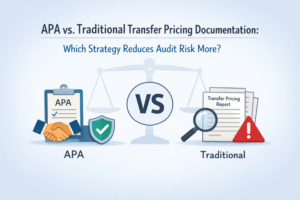
1. What Is an APA?
An Advance Pricing Agreement (APA) is a formal agreement between a taxpayer and the IRS (and sometimes foreign tax authorities) that establishes transfer pricing methodology for future years. APAs may be:- Unilateral (between taxpayer and IRS)
- Bilateral (between IRS and foreign authority)
- Multilateral (involving multiple jurisdictions)
2. What Is Traditional Transfer Pricing Documentation?
Traditional documentation refers to contemporaneous transfer pricing reports prepared annually to comply with Section 6662 requirements. Documentation typically includes:- Functional analysis
- Method selection explanation
- Economic benchmarking
- Financial reconciliation
- Intercompany agreements
3. Audit Risk Comparison
Traditional Documentation
Reduces penalty exposure if prepared correctly. Does not eliminate risk of:- Income reallocation
- Multi-year audit disputes
- Double taxation
APA
Provides pre-approved methodology. Substantially reduces:- Audit disputes
- Adjustment volatility
- Penalty risk
4. Cost and Administrative Burden
Traditional Documentation
- Lower upfront cost
- Annual refresh required
- Flexible method updates
APA
- Significant upfront cost
- Multi-year negotiation process
- Detailed disclosures required
- Ongoing annual reporting obligations
5. When an APA Makes Strategic Sense
An APA is often appropriate when:- Persistent foreign losses trigger scrutiny
- Profit split method is applied
- Intangibles are highly valuable
- Multiple jurisdictions challenge pricing
- Prior audits resulted in adjustments
6. When Traditional Documentation Is Sufficient
Traditional documentation may be sufficient when:- Transactions are limited in scope
- Tested party earns routine margins
- No history of audit disputes
- Foreign authorities are low-risk
- Profit allocation is straightforward
7. Interaction with IC-DISC Structures
Export-driven companies using IC-DISC must coordinate transfer pricing strategy carefully. An APA affecting distributor margins may:- Increase or decrease U.S. profitability
- Affect IC-DISC commission base
- Change global effective tax rate
- Federal export incentives
- State tax exposure
- Shareholder-level dividend taxation
8. Global Coordination Considerations
With increased international cooperation under OECD initiatives and Pillar Two global minimum tax rules, bilateral APAs are becoming more attractive. Benefits include:- Reduced double taxation
- Greater cross-border consistency
- Improved investor confidence
9. Strategic Decision Framework
Companies evaluating APA vs documentation should assess:- Size of cross-border transactions
- Industry risk profile
- Prior audit history
- Margin volatility
- Administrative capacity
- Cost tolerance
- Long-term structural stability
10. Hybrid Approach
Some companies adopt a hybrid model:- Maintain strong traditional documentation
- Monitor audit exposure
- Pursue APA only if disputes escalate
Key Takeaways
Traditional transfer pricing documentation provides penalty protection but not audit certainty. An APA provides certainty but requires substantial investment and disclosure. Mid-market multinationals — particularly aerospace exporters and complex manufacturing groups — should evaluate whether the cost of uncertainty exceeds the cost of an APA. Transfer pricing governance should align with broader international tax and IC-DISC strategy to preserve both tax efficiency and audit defensibility.Frequently Asked Questions: APA vs. Transfer Pricing Documentation
Q1: What is the fundamental difference between an Advance Pricing Agreement (APA) and traditional transfer pricing documentation?
A1: An Advance Pricing Agreement (APA) is a formal, forward-looking agreement between a taxpayer and tax authorities (IRS, and potentially foreign tax authorities) that establishes a transfer pricing methodology for future years, providing certainty and reducing audit disputes. In contrast, traditional transfer pricing documentation refers to contemporaneous reports prepared annually to comply with Section 6662 requirements, offering penalty protection but not preventing audit adjustments or disputes.
Q2: In what scenarios does an APA offer a strategic advantage over traditional documentation?
A2: An APA makes strategic sense when companies face persistent foreign losses triggering scrutiny, apply the profit split method, possess highly valuable intangibles, encounter challenges to pricing from multiple jurisdictions, or have a history of audit adjustments. It is particularly beneficial for high-risk industries or businesses undergoing significant restructuring.
Q3: What are the primary cost and administrative burden considerations for APAs versus traditional documentation?
A3: Traditional documentation generally involves a lower upfront cost and requires annual refreshes with flexible method updates, making it suitable for mid-market exporters with routine structures. APAs, however, entail significant upfront costs, a multi-year negotiation process (18-36 months), detailed disclosures, and ongoing annual reporting obligations. For smaller companies, the cost of an APA may outweigh its benefits.
Q4: How does an APA interact with IC-DISC structures for export-driven companies?
A4: For export-driven companies utilizing IC-DISC, an APA affecting distributor margins can significantly impact U.S. profitability, the IC-DISC commission base, and the global effective tax rate. It is critical to model the impact on federal export incentives, state tax exposure, and shareholder-level dividend taxation before pursuing an APA, emphasizing the need for integrated tax planning.
Q5: When might traditional transfer pricing documentation be considered sufficient?
A5: Traditional documentation may be sufficient when transactions are limited in scope, the tested party earns routine margins, there is no history of audit disputes, foreign authorities are low-risk, and profit allocation is straightforward. For many mid-market exporters using methods like the Comparable Profits Method (CPM) or Transactional Net Margin Method (TNMM), well-prepared documentation can provide adequate protection against penalties.