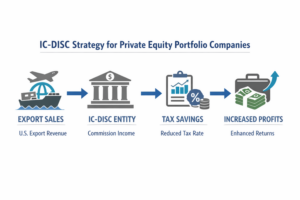
1. Why IC-DISC Matters in a PE Context
An IC-DISC allows U.S. exporters to convert a portion of export income into qualified dividend income taxed at favorable rates. For portfolio companies engaged in:- Aerospace and aircraft parts exports
- Industrial equipment manufacturing
- Technology hardware exports
- Agricultural equipment distribution
- Increased after-tax distributable cash
- Potential EBITDA impact depending on commission structure
2. EBITDA and Structural Considerations
IC-DISC commissions are deductible by the operating company and paid to the IC-DISC entity. Key structuring considerations include:- Shareholder ownership alignment
- Dividend distribution strategy
- Management incentive participation
- Holding company placement
- The portfolio company shareholders
- A holding entity
- Management participants (strategic incentive tool)
3. Diligence Red Flags in Existing IC-DISC Structures
When evaluating a target company, private equity firms should assess:- Whether IC-DISC qualification criteria are properly met
- Whether annual redeterminations are performed
- Whether export documentation is maintained
- Whether commission calculations are optimized
- Whether transfer pricing policies conflict with commission modeling
- IC-DISC established but never optimized
- Static commission method used for years
- Failure to include related-party export sales
- No coordination with transfer pricing studies
4. Pre-Acquisition Modeling
Sponsors should conduct modeling during quality-of-earnings analysis to determine:- Maximum allowable commission under 4% or 50% method
- Marginal tax rate arbitrage
- Interaction with GILTI and foreign tax credits
- State tax implications
5. IC-DISC and Exit Strategy
Before a sale or recapitalization, sponsors should reassess:- Commission redeterminations
- Dividend distributions timing
- Retained earnings strategy
- Compliance documentation
- Sustainability of tax savings
- Exposure to IRS challenge
- Transfer pricing alignment
- Contemporaneous documentation
6. Interaction with Transfer Pricing
For multinational portfolio companies, IC-DISC strategy must align with transfer pricing. If foreign distributors are overcompensated under a transfer pricing study, the U.S. profit base — and therefore IC-DISC commission — may shrink. Coordinated modeling ensures:- Defensible distributor margins
- Maximized export commission base
- Reduced double taxation risk
7. Annual Redetermination: A Missed Opportunity
Many companies establish IC-DISC entities but never revisit commission calculations. Annual redeterminations allow recalculation under alternative methods to maximize allowable commission. In sponsor-owned companies experiencing growth or margin fluctuation, this can materially increase savings. Failing to perform redeterminations is one of the most common missed value drivers in the mid-market.8. Audit Defense and Risk Mitigation
Private equity sponsors must ensure:- Export property qualification analysis is current
- Intercompany agreements are updated
- Transfer pricing documentation supports profit allocation
- IC-DISC books and records are maintained
9. When IC-DISC May Not Be Appropriate
IC-DISC may be less effective when:- Export margins are minimal
- The business is primarily service-based
- Significant foreign manufacturing reduces U.S. export base
- Ownership structure complicates dividend taxation
Key Takeaways
For private equity portfolio companies engaged in exporting tangible goods, IC-DISC remains a powerful but underutilized planning strategy. When implemented strategically and coordinated with transfer pricing and international tax planning, IC-DISC can:- Increase free cash flow
- Improve debt capacity
- Enhance exit valuation
- Reduce audit exposure
Frequently Asked Questions: IC-DISC Strategy for Private Equity Portfolio Companies
Q1: Why is the IC-DISC a powerful, yet often overlooked, value-creation tool for private equity firms investing in export-driven businesses?
A1: The IC-DISC (Interest Charge Domestic International Sales Corporation) allows U.S. exporters to convert a portion of export income into qualified dividend income taxed at favorable rates. For private equity firms, this translates into increased after-tax distributable cash and potential EBITDA impact, depending on the commission structure. Even if EBITDA is unaffected by commission expense, enhanced free cash flow improves debt service capacity and valuation attractiveness, making it a significant lever for improving exit multiples and overall transaction value.
Q2: How do IC-DISC commissions impact EBITDA, and what are the key structural considerations for private equity-backed companies?
A2: IC-DISC commissions are deductible by the operating company and paid to the IC-DISC entity. This deduction can decrease EBITDA. Key structural considerations for private equity-backed companies include shareholder ownership alignment, dividend distribution strategy, management incentive participation, and holding company placement. Early structuring decisions, such as whether IC-DISC shares are owned by portfolio company shareholders, a holding entity, or management participants, determine how tax savings flow through the capital stack and influence valuation presentation.
Q3: What are common red flags private equity firms should look for during due diligence of existing IC-DISC structures in target companies?
A3: During due diligence, private equity firms should assess whether IC-DISC qualification criteria are properly met, if annual redeterminations are performed, if export documentation is maintained, if commission calculations are optimized, and if transfer pricing policies conflict with commission modeling. Common issues include IC-DISC structures that were established but never optimized, static commission methods used for years, failure to include related-party export sales, and a lack of coordination with transfer pricing studies. These gaps can reduce value and create significant diligence risk.
Q4: How does IC-DISC strategy need to be coordinated with transfer pricing for multinational portfolio companies?
A4: For multinational portfolio companies, IC-DISC strategy must be closely aligned with transfer pricing policies. If foreign distributors are overcompensated under a transfer pricing study, the U.S. profit base—and consequently the IC-DISC commission—may shrink. Coordinated modeling ensures defensible distributor margins, a maximized export commission base, and reduced double taxation risk. Fragmented advisory approaches in these areas frequently erode value and increase audit exposure.
Q5: What are the critical steps private equity sponsors should take regarding IC-DISC before a portfolio company’s exit?
A5: Before a sale or recapitalization, private equity sponsors should reassess commission redeterminations, dividend distribution timing, retained earnings strategy, and compliance documentation. Well-documented and optimized IC-DISC structures reduce buyer diligence friction, as buyers increasingly evaluate the sustainability of tax savings, exposure to IRS challenge, transfer pricing alignment, and contemporaneous documentation. A weak IC-DISC structure can negatively impact purchase price adjustments and overall exit valuation.