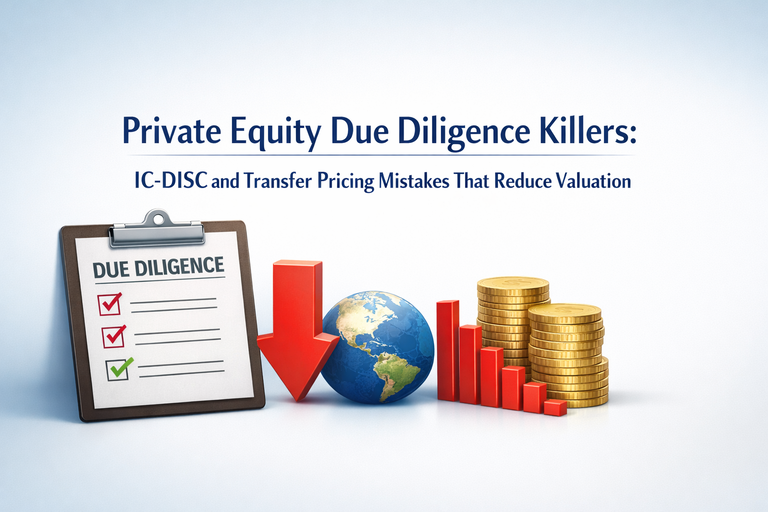
Introduction: Tax Issues Don’t Kill Deals—Surprises Do
Private equity firms expect tax complexity. What they don’t tolerate are undisclosed risks, unsupported structures, and post-close cleanup costs that erode returns. IC-DISC and transfer pricing issues consistently surface during due diligence—not because the concepts are flawed, but because they are often poorly implemented, under-documented, or misunderstood by management teams. When these problems appear late in the deal process, they reduce valuation, trigger escrows, or force purchase price adjustments.Killer #1: IC-DISC Structures That Cannot Be Defended
Many sellers present IC-DISC benefits as guaranteed tax savings. Due diligence teams immediately ask one question: Can this survive an audit?Common Red Flags
- Commission calculations unsupported by contemporaneous documentation
- Qualification assumptions based on outdated revenue or product classifications
- No evidence of annual IC-DISC redeterminations
Killer #2: Transfer Pricing That Exists Only on Paper
Transfer pricing that looks fine in a report but does not reflect operational reality is a valuation liability.Due Diligence Triggers
- Inconsistent intercompany pricing year over year
- Benchmarks that no longer match functional profiles
- Profit allocations misaligned with value creation
Killer #3: Double-Counting Benefits Across Tax Strategies
Some sellers stack IC-DISC benefits, R&D credits, and transfer pricing adjustments without understanding interaction effects. From a buyer’s perspective, this raises two concerns:- Are benefits overstated?
- Will the IRS challenge inconsistent positions?
Killer #4: No Alignment Between Tax Structure and Supply Chain
Supply chain changes—especially offshoring or foreign distribution—frequently break existing tax models.Structural Misalignment Examples
- IC-DISC commissions disconnected from actual sales flows
- Transfer pricing that ignores post-restructuring functions
- Contract manufacturing treated like full-risk manufacturing
- International Supply Chain Restructuring for Valuation and Transfer Pricing
- International Tax Planning for Exporters
Killer #5: Audit Exposure No One Quantified
Buyers don’t just assess savings—they price risk. IC-DISC and transfer pricing risks become valuation issues when:- Audit exposure has not been modeled
- Penalties and interest are ignored
- Documentation gaps are discovered late
How These Issues Hit Valuation
Private equity firms respond to tax uncertainty in predictable ways:- Reduced EBITDA adjustments
- Escrow or holdback requirements
- Indemnities with aggressive survival periods
- Lower purchase multiples
How to Fix These Issues Before a Sale
The strongest sellers address tax risks before diligence begins.Pre-Sale Best Practices
- Refresh IC-DISC calculations and documentation
- Align transfer pricing with current operations
- Eliminate double-counted benefits
- Quantify audit exposure with realistic assumptions