The IC-DISC: A Primer for U.S. Exporters
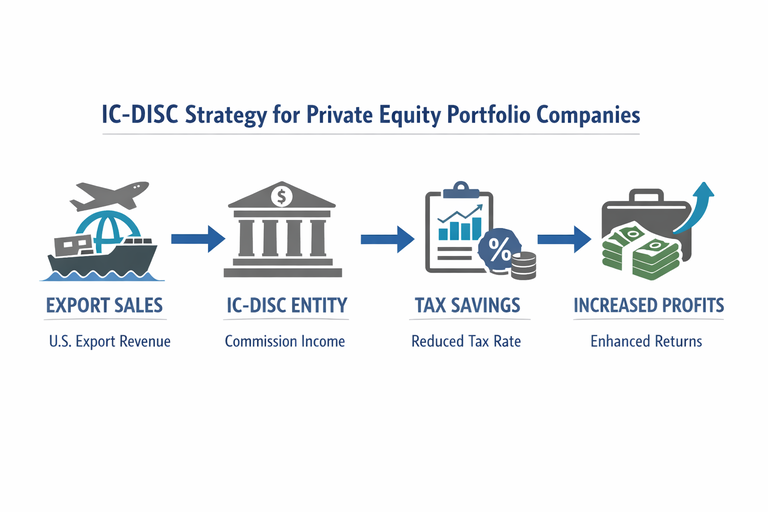
Established in 1984, the IC-DISC is a tax-advantaged entity that allows U.S. exporters to reduce federal income tax liabilities on qualified export income. Its primary goal is to incentivize American businesses to compete globally by lowering the effective tax rate on export profits.Who Benefits?
- Manufacturers of goods produced in the U.S. (e.g., aerospace components, machinery, software).
- Distributors that sell U.S.-made products overseas.
- Service Providers in engineering, architecture, and agriculture.
How It Works
- For S Corporations & Partnerships: Export income is shifted to the IC-DISC, which does not pay federal taxes. When distributed as dividends, this income is taxed at the qualified dividend rate (currently capped at 20%), saving 5.8%–17% compared to ordinary income rates (up to 37%).
- For C Corporations: The IC-DISC can pay deductible dividends (saving 13.125%–21%) or additional tax-advantaged compensation to shareholder-employees.
The Problem with Traditional IC-DISC Calculations
Most tax advisors calculate IC-DISC benefits using a “big picture” approach:- Aggregate total export sales and profits.
- Apply a standard commission rate (typically 4% of export income or 50% of taxable income).
- Profit Variability: High-margin transactions are lumped with low-margin ones, diluting potential savings.
- Overlooked Deductions: Indirect costs (e.g., R&D, marketing) may not be fully allocated to individual transactions.
- Regulatory Complexity: The IRS permits 18 distinct calculation methods, but most firms use just one.
WTP Advisors’ Solution: The Transactional Method (TxT)
WTP Advisors’ proprietary Transactional Method (TxT) revolutionizes IC-DISC planning by analyzing every export transaction individually. Here’s how it works:Step 1: Transaction-Level Analysis
Each invoice is evaluated using the most favorable of 18 IRS-approved calculation methods, such as:- Gross Receipts Method: 4% of gross export sales.
- Combined Taxable Income (CTI) Method: 50% of net export profit.
- Marginal Costing: Allocates costs to maximize deductible expenses.
Step 2: Data Validation with Exportal
WTP Advisors’ proprietary software, Exportal, automates data processing and compliance checks. It:- Validates export documentation (e.g., shipping records, bills of lading).
- Ensures alignment with IRS IC-DISC guidelines.
- Generates audit-ready reports to preempt disputes.
Step 3: Strategic Tax Mapping
Exportal also identifies opportunities to:- Reclassify non-export income as qualified.
- Optimize R&D and SG&A expense allocations.
- Mitigate risks from the “No Loss Rule” (which limits commissions if the exporter shows a net loss).
Case Study: 263% Savings for an Aerospace Manufacturer
Client Profile
- Industry: Aerospace parts manufacturing & distribution.
- Structure: S Corporation.
- Export Sales: $43 million annually.
Initial Challenge
The client had used a traditional IC-DISC strategy for years, calculating commissions at 4% of export sales (770,000).While this yielded 770,000).While this yielded 44,765 in annual tax savings, leadership suspected they were missing opportunities.WTP Advisors’ Intervention
- TxT Implementation: Exportal analyzed all $43 million in export transactions, applying the optimal calculation method to each.
- Maximized Commissions: By blending Gross Receipts, CTI, and Marginal Costing methods, commissions surged to $2.8 million—a 263% increase.
- Tax Savings: At a 6.7% rate spread, savings jumped to 162,687∗∗,with∗∗162,687∗∗,with∗∗117,922 in incremental cash vs. the traditional approach.
Operational Impact
The CFO noted: “Switching to TxT freed up capital we’ve redirected into R&D and inventory expansion. It’s been a game-changer for our growth.”Why Traditional Methods Fail—And Why TxT Succeeds
1. One-Size-Fits-All vs. Precision
Traditional methods apply a uniform rate to all transactions, even though profit margins vary widely. For example:- High-Margin Part A: 25% profit margin → CTI method (50% of 250k profit=250k profit=125k commission).
- Low-Margin Part B: 5% profit margin → Gross Receipts method (4% of 100k sales=100k sales=4k commission).
2. Ignoring Indirect Costs
Traditional approaches often underallocate SG&A or R&D expenses to individual transactions. TxT uses activity-based costing to maximize deductible expenses, lowering taxable income.3. Compliance Risks
Simplified calculations may not withstand IRS scrutiny. Exportal’s documentation ensures every commission is defensible.Beyond Aerospace: Industries That Benefit from TxT
While this case focuses on aerospace, TxT is equally impactful for:- Agriculture: Exporters of grains, livestock, or machinery.
- Tech: Software developers with overseas subscriptions.
- Renewables: Manufacturers of solar panels or wind turbines.
Why Partner with WTP Advisors?
With 30+ years of IC-DISC expertise, WTP Advisors stands apart through:- Proprietary Technology: Exportal guarantees accuracy and compliance.
- Deep Regulatory Knowledge: Up-to-date insights on IRS rulings and global tax treaties.
- Holistic Tax Strategy: Align IC-DISC with R&D credits, FDII, and cross-border structures.
Conclusion: Transform Tax Liabilities into Growth Capital
The IC-DISC is not just a tax incentive—it’s a strategic lever for global competitiveness. For the aerospace manufacturer, WTP Advisors’ TxT method turned a routine tax calculation into a $117,922 annual cash infusion, proving that precision and innovation drive results. As supply chains grow more complex, exporters can’t afford to rely on outdated methods. By embracing transaction-level analysis, businesses can reclaim millions in overlooked savings—fueling expansion, innovation, and resilience in an unpredictable market. Ready to Maximize Your IC-DISC Savings? Contact WTP Advisors’ experts today:- Jim Fyhrie, CPA Principal, CIO & Co-Founder +1 (866) 298-7829 EXT 700 | jim.fyhrie@wtpadvisors.com
- Brian Schwam National Managing Director – International Tax Services +1 (866) 298-7829 EXT 701 | brian.schwam@wtpadvisors.com